Cerasuolo d’Abruzzo—Pairs Well with Thanksgiving and Sonny & Cher’s All I Ever Need Is You
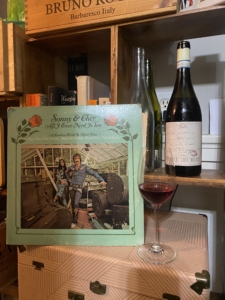
I often hesitate when people ask me what my favorite wine is. My preference goes in phases, and there is just so much good wine out there! You could spend your whole life tasting through the native grapes of Italy alone. But if I had to pick one wine to drink forever—as much as it pains me to exclude all the wonderful and infinite wines of the world—it would be Italy’s undervalued and inconspicuous Cerasuolo d’Abruzzo.

Made with the montepulciano grape, Cerasuolo means “cherry-red” or “cherry-like,” referencing both the color and general flavor profile of the wine. This magenta-hued rosé, which sometimes poses as a very light, slightly tannic red, is a chameleon—it goes with almost anything. With the Thanksgiving spread being both a predictable and unpredictable myriad of sweet, salty, herby, and tangy, this wine is so incredibly versatile that it will adapt to almost any bite. The marshmallow-on-top is that it’s simply and unequivocally delicious and is sure to please whoever takes a sip.

At Paul Marcus Wines, there is unanimous consensus among buyers and staff that Cerasuolo d’Abruzzo rocks our socks—so much so we often carry multiple options from different producers. We think the three detailed below drink ultra tasty, yet differently enough that they all deserve a place on your table for the Thanksgiving holiday (and, frankly, year-round).

Cerasuolo, All I Ever Need Is You.

Torre dei Beati

Torre dei Beati’s next-door neighbor is arguably the most famous wine grower in Abruzzo—Eduardo Valentini. If you can even find a bottle of Valentini, you’ll be lucky if you spend less than $200. Torre dei Beati offers a range of classic Abruzzese wines from the same terroir for far less. Montepulciano is so vigorous that it can (and often is) boring or flabby—hence our association with a generic table wine. But when yields are curbed, along with organic and intentional grape growing in this grand-cru area of Loreto Aprutino, the difference is uncanny.

The estate is certified organic, and the combination of elevation and clay-limestone soils ensures delicacy and elegance—in addition to careful farming, limited yields, and minimal cellar tinkering. The final wine is a result of saignée, blanc de noir, and maceration, all blended into one dynamic wine. You’ll find cherry Jolly Rancher, blood orange, grapefruit, saline minerality, and deep, complex, nuanced hints of lavender and rose.

Tiberio

Azienda Agricola Tiberio had late beginnings, at least when you compare their story and trajectory to historic and family-crested cantine (wineries). About 25 years ago, Riccardo Tiberio jumped at the opportunity to purchase eight hectares of old-vine Trebbiano Abruzzese, understanding the grape’s potential (the same grape that brought widespread acclaim to Valentini). In 2008, his children Cristiana and Antonio took over. Cristiana is a chemist by trade, and she approaches her winemaking with the same methodical curiosity, while Riccardo spends his days in the vineyards.

This Cerasuolo is true to the Abruzzese tradition in that it is rich and dark. The tannin is surprisingly soft considering how dark the wine is, but it’s still a wine that will hold up through your entire meal. With notes of red cherry, petrichor, sage, and antique rose, it is soft and round.

Amorotti

Amorotti is a young winery that has deep roots in the farming history of Abruzzo. It is run by Gaetano Carboni, a lawyer who chose to dedicate himself to his family farm instead of practicing law. (Amorotti is the maiden name of Carboni’s mother.) In 1905, his grandfather was the first Italian extra-virgin olive oil producer to export to the U.S. Today, the family runs an olive oil museum in an ancient castle in the heart of the central Abruzzo town of Loreto Aprutino, displaying old production methods, vintage pictures, and tools.

The vineyards have belonged to the Amorotti/Carboni family for more than a century, and the wine is produced in the same cavernous cellar that the family has always used for their personal consumption. In 1992, Gaetano refurbished the cellar, and a few years later, he started uprooting old vines to plant new stock. Only recently did he decide to start bottling the best grapes they harvest, and the 2016 vintage was his first release. Carboni also continues to produce olive oil to this day, and together with his wife, he runs an agriturismo with a focus on contemporary art where they host a series of artists-in-residence programs. The entire property is certified organic.

Amorotti’s Cerasuolo is intentionally more serious and age-worthy than the other two. It is more reductive and flinty, and amongst wine pros is compared to the big names of Abruzzo: Valentini and Emidio Pepe. Pleasant smoky reduction dissipates to reveal dried sage, wild strawberries, stone dust, and violet, with salty minerals to balance. Crisp wild berry and blood orange complete the picture.
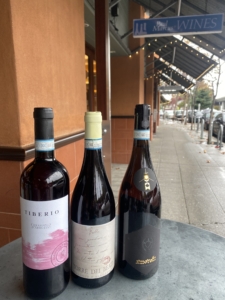
All these Cerasuolo selections use organic grapes and apply minimal intervention in the cellar, with only native yeast and spontaneous fermentation. Some might use the term “natural” to describe these methods. However, these wines are not “natty” and display no flaws. (Yes, it is possible to drink natural wine that doesn’t taste like burning manure.)

These Cerasuoli will make a convert out of you, whether you swing natty or not. If you’d like to sample them all, we are currently offering a 15 percent discount on our Cerasuolo three-pack. So bust out the Sonny & Cher, and learn more about this fascinating DOC.

— Emilia Aiello

California Cool—Restraint in the Golden State

The Turkey Day table is often such a super abundance of foods that you must go basic when pairing wine. How do we survive this? Our advice is always the same—drink what makes you happy. But for those who believe a national holiday deserves a national drink, we offer some suggestions.
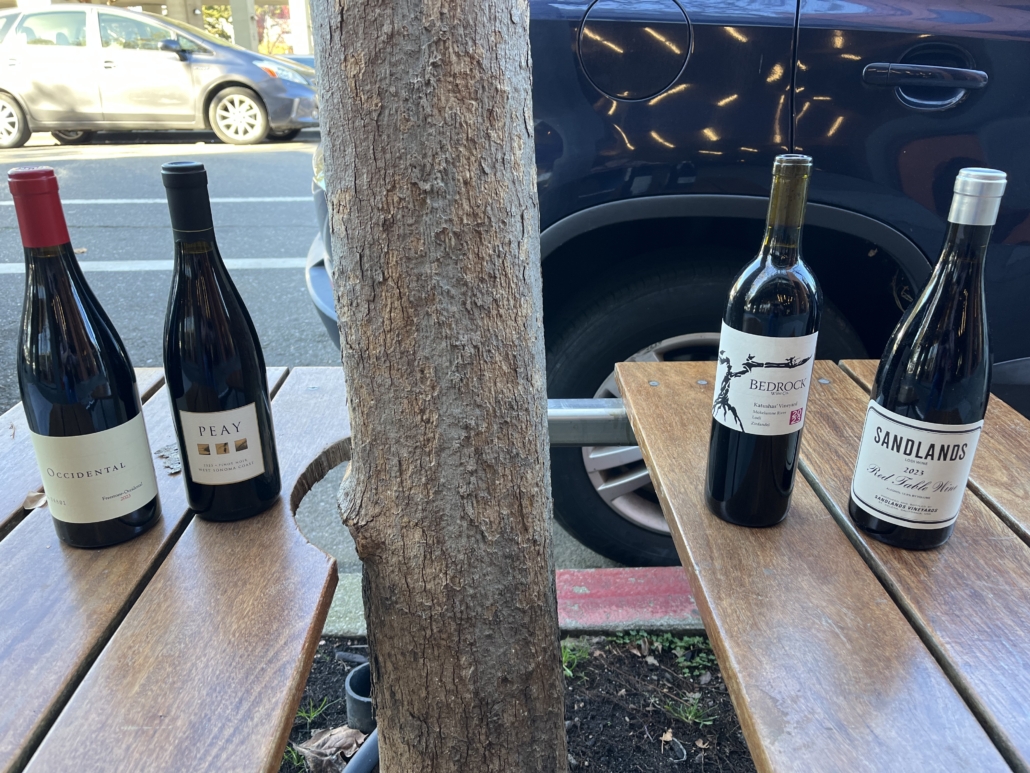
Often, California wine regions are drawn over-broad and without homogeneity of values or style, resulting in useless generalizations about the wines. But occasionally, we get it right, and carving the West Sonoma Coast out of the too large Sonoma Coast AVA has made the label meaningful. The area is so cool and the fog and breeze off the ocean so consistent that ripening pinot above 13 percent potential alcohol is a challenge, not a given.

And it just so happens that turkey and cranberry pair very well with the less-oaked, red-spectrum fruits you consistently get from these wines. We have some of the best examples from the West Sonoma Coast region—Peay and Occidental come to mind, but we have many other options.

Some would say there’s no more American wine than zinfandel; it has proved capable of thriving in California longer than any other grape.  Another victory in meaningful wine labels comes from the new Mokelumne River AVA, a sub-zone of Lodi. If you remember Lodi as shorthand for very ripe and alcoholic wines, you’ll be quite surprised by what’s currently going on.

I thought Arnot-Robert’s exciting Kirschenmann Vineyard zin was an outlier, more a product of that winery’s style than an exemplar of place. But now I’m not sure. Bedrock’s Katushas’ Vineyard is in the same area (and also well more than 100 years old) and is similarly delicious—dark-fruited and gently textured, yet with freshness and not heavy. The farmer most associated with preserving ancient vineyards in California, Tegan Passalacqua, has taken special interest in the area and is making wonderful wines under his Sandlands label. All would make great selections for your holiday feast.

— David Gibson

Chinon—Gem of the Loire

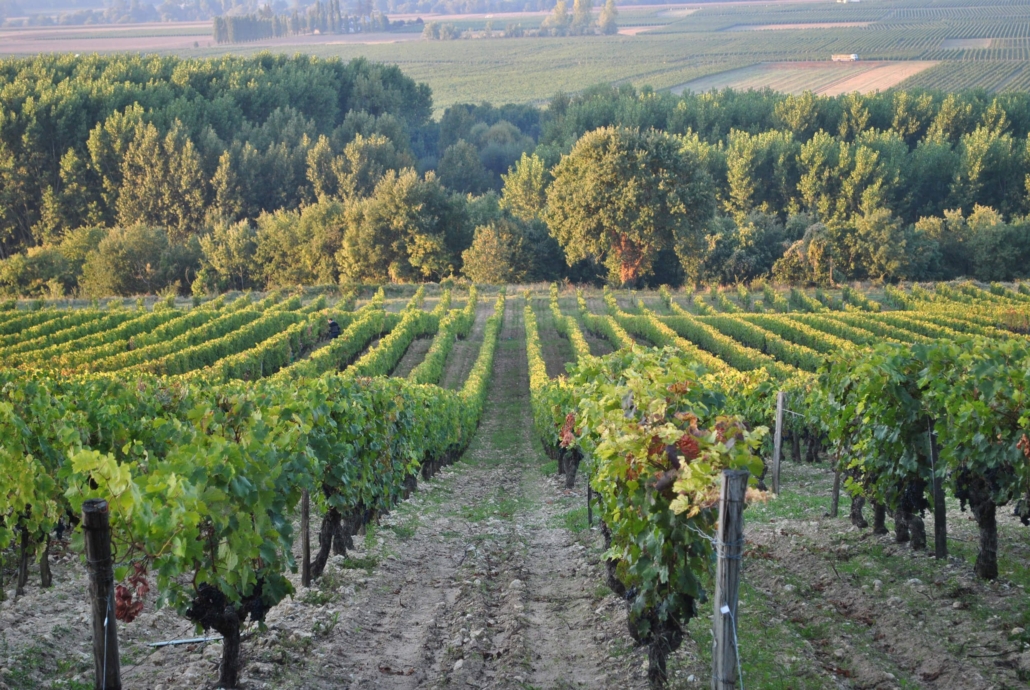
Once considered a worthy rival to Bordeaux, the Chinon appellation sits in the heart of the Loire Valley, where it is exposed to both cooling coastal breezes and inland warmth. Almost all of the wine produced in Chinon is cabernet franc, save for a tiny output of chenin blanc. Cab franc from Chinon is a study in balance—fresh and vibrant, but often with considerable depth, and boasting a range of flavors from fruity to savory to herbaceous to earthy.
the Baudry estate

At Paul Marcus Wines, one of our favorite Chinon producers is Bernard Baudry, who owns 32 hectares of vineyards in the AOC and offers a variety of distinct cuvées. ‘Les Grézeaux,’ the domaine’s oldest plot (more than 60 years), is located in the plains near the Vienne River, where the gravelly soils produce wines with a velvety texture and aromatic lift. It has enough meat on its bones to stand up to heartier fare, but the smooth tannins and modest 12.5 percent alcohol allow it to pair eloquently with a whole host of dishes. We also have Baudry’s stunning ‘La Croix Boissée,’ which comes from further up the slope, where Chinon’s renowned limestone-rich soil (called tuffeau) is prevalent. A wine of intensity, gracefulness, and complexity, it is a shining example of what Chinon can offer.

Domaine Philippe Alliet is another esteemed Chinon producer, and their wines tend to come off as a bit “cleaner” than that of other producers in Chinon—not as leafy and earthy, not as meaty, but pure and precise. In addition, we have the ‘Varesnes’ offering from Domaine Jourdan, which comes from a part of the plain where the soil is clay-heavy, giving the wine a notably spicy tinge. Fermented in steel and aged in concrete, it is a structured and mineral wine, but the omission of any oak helps the wine maintain elegance and equilibrium.

— Marc Greilsamer
There’s a reason why nebbiolo is one of the world’s most treasured grapes. Few others can deliver its total package—gorgeous fruit, supportive tannins, bright acidity, elegant spice, and earthy charm. When done correctly, nebbiolo offers balance, complexity, intensity, and finesse of which most grapes can only dream. It’s also an incredibly versatile variety, producing wines in a wide range of styles, each accentuating different characteristics.

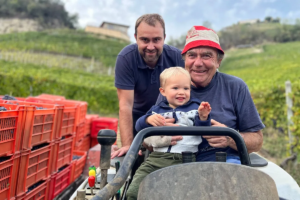
Three generations: Luca Roagna with father and son

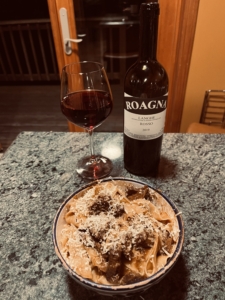
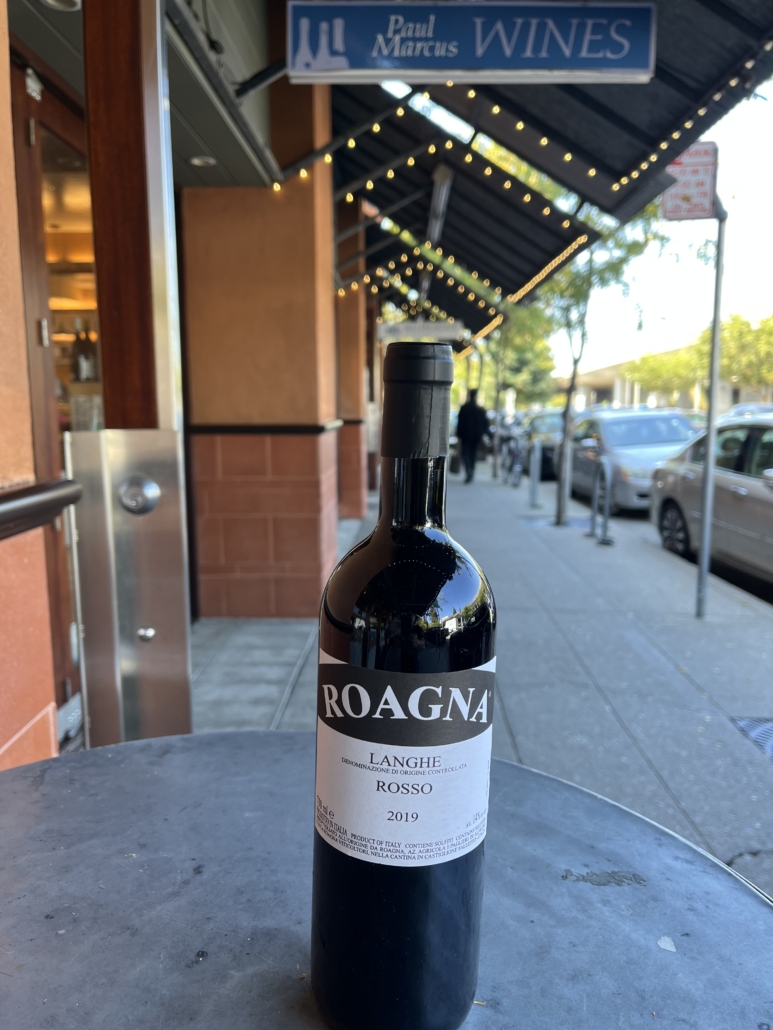
At Paul Marcus Wines, we are no strangers to nebbiolo. From highly prized Barolo and Barbaresco to young and fresh table wines, our shelves boast a wide selection of nebbiolo in almost every incarnation. Occasionally, we get a version that stands apart from the others, and that certainly is the case with the 2019 Roagna Langhe Rosso.

In the capable hands of Luca Roagna, this estate puts out some of the world’s most prestigious Barolo and Barbaresco. But this more “modest” offering—50 bucks—is a stunner in its own right. The grapes come from younger vines in Barolo and Barbaresco, and the wine is crafted in pretty much the same way as its more esteemed siblings.

As soon as you pull the cork, a brilliant burst of perfumed raspberries pops out of the bottle. Though it leans toward a floral and graceful style—more roses than tar—it has a bedrock of refined, well-integrated tannins that underpins the lovely and delicate fruit and exotic spice notes rather than overwhelming them. It’s lively and expressive while maintaining its backbone and edge—a wonderful example of the outstanding, old-school 2019 vintage. Slow-braised beef, anyone?

Yes, you can probably lay it down for a few years and be amply rewarded, but in all honesty, it’s hard to imagine it being any more satisfying than it is today. We have a handful of bottles left, so there’s still time to find out for yourself.

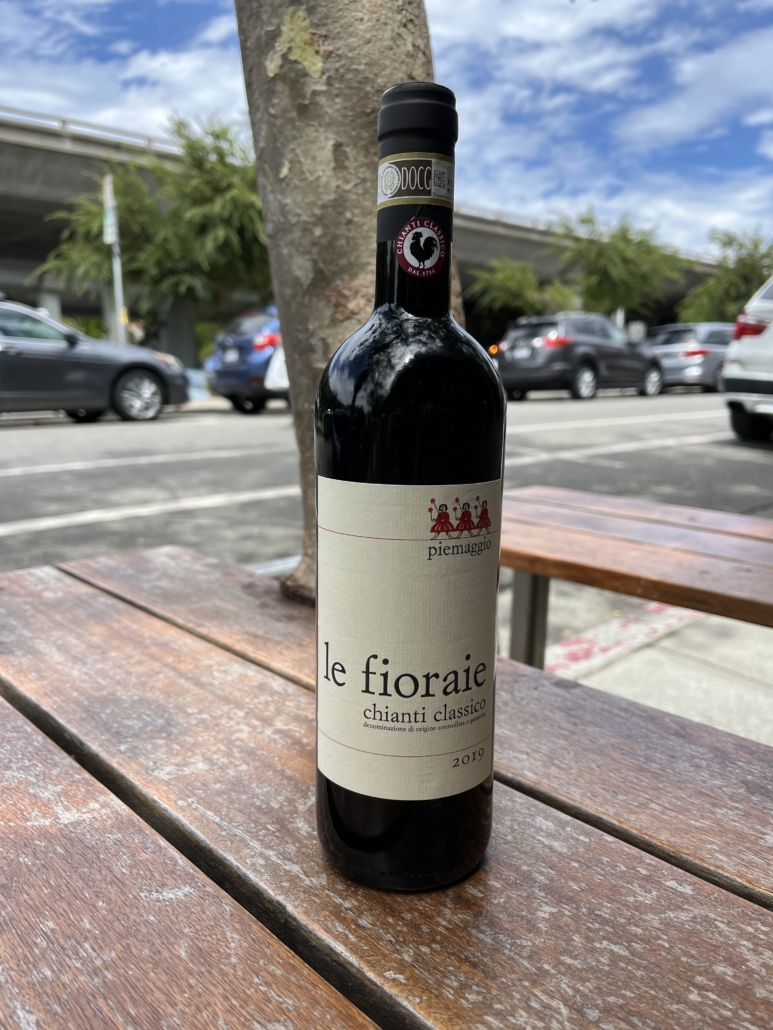
Every so often, we encounter a wine that turns out to be a surprise hit with our customers. After a week or two on the shelves, the wine continues to build momentum, and we notice that we need to reorder more frequently and in higher quantities. Piemaggio’s Chianti Classico is such a wine. And it isn’t just the clientele who have responded so positively. Several members of the PMW staff have enjoyed a bottle at home and come back to the shop singing its praises.
The Piemaggio estate is located in the hamlet of Le Fioraie (the flower sellers) on the northwest slopes of Castellina in Chianti. According to legend, three young flower sellers revived a traveling friar in the 10th century with a glass of wine. He never forgot their efforts and later returned to build a church and plant vines.

Surrounded by forest on all sides, the 12 hectares of sangiovese (and small amounts of colorino, canaiolo and ciliegiolo) grow at altitudes between 380 and 480 meters. The wine undergoes spontaneous fermentation in stainless-steel tanks and is then aged in a combination of concrete, Slavonian oak, and French oak.

For the superb 2019 vintage, the result is this beautifully balanced, traditional, structured wine of intensity and finesse. It is bright and elegant enough to match with simple tomato-based pizzas and pastas, yet offers the power and complexity to stand up to more serious, robust fare. And, at $29, it sports a great quality-to-price relationship.

“Wow! The Piemaggio is so good,” say both co-workers and customers. Come visit us at Paul Marcus Wines and see for yourself. Don’t miss this one!

According to some, there are two kinds of people in the world: those who wonder “how it works” and those who ponder “what it does.” The “it” could be a tool or a machine or a process. Put another way, some folks focus on how a final product is achieved while others focus on the various characteristics of the final product itself.

Since I’ve always been more of a “what does it do” guy than a “how does it work” guy, I will mostly sidestep the chemistry aspect of lees aging (proteins and enzymes and the like) and turn our attention to the final product. How does lees aging affect the wine in your bottle?

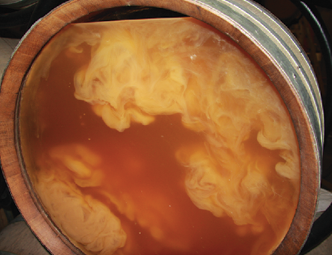
Lees aging is a winemaking regimen in which the juice is not cleared of its fermentation residue. After the yeast is introduced and the process of fermentation–converting sugar to alcohol–is complete, the dead yeast (lees) sinks to the bottom of the vat or barrel. At that point, the winemaker might decide to leave the juice in contact with this milky byproduct for an extended period. Depending on how much lees influence is sought, the juice can be stirred (a process called bâtonnage) to increase its effect.
For starters, lees contact will give the wine richness, depth, and warmth. It helps to smooth a wine’s rougher edges while adding complexity and breadth to the flavors and aromas. Lees aging might also help stabilize a wine by helping to fend off oxidation. Producers of “serious” wines from Champagne and Burgundy have traditionally relied on lees aging, but so have makers of sleeker, mineral-driven wines such as Muscadet and Galician albariño.

To me, there is a certain sweet spot when it comes to lees aging–when the technique takes place in stainless-steel tanks. The combination of stainless steel and lees contact gives a wine creaminess and texture without sacrificing acidity. It creates wines that are fleshy but still fresh, and it lends the wine a bit of weight and gravity while maintaining expressive, bright fruit. It offers some characteristics associated with wood aging, but with a more restrained touch.

I find that wines made in this style are often perfect for rich, shellfish-based dishes. At Paul Marcus Wines, we offer a wide range of white wines made in this steel-plus-lees style that are worth discovering, including three of particular note:

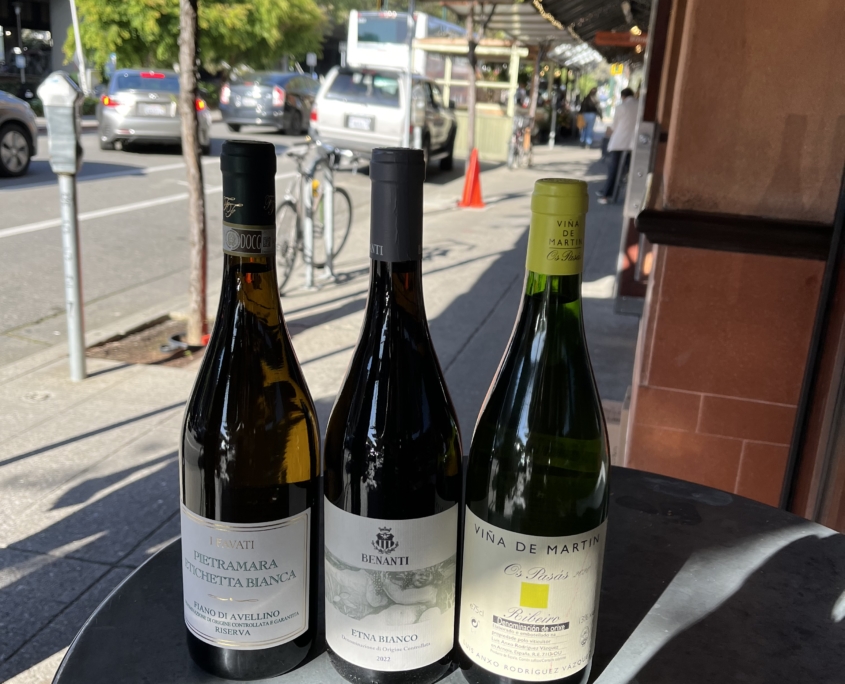
2019 I Favati Fiano di Avellino – Pietramara Etichetta Bianca

Fiano from the hills of Campania is perhaps the most esteemed white grape in all of Italy, and this multifaceted bottling offers ample proof why–especially when accompanying casarecce with rock shrimp in a spicy tomato-cream sauce.

2022 Benanti Etna Bianco

Made with 100 percent carricante from the eastern and southern slopes of Sicily’s Mt. Etna, this bright, gently smoky, beautifully balanced wine will shine alongside brinier dishes such as steamed clams and mussels in a lemon and white wine broth.

2020 Luis Rodriguez Ribeiro – Os Pasás

Predominantly treixadura, and filled out with small amounts of albariño, torrontés, and lado, this Galician stunner would pair well with gambas al ajillo (garlic shrimp) atop buttery white beans.

These three wines seem to have much in common: distinct minerality, lovely texture, and a subtle tropical vibe–melon and mango and such–along with a cleansing salinity. We are talking about dynamic, age-worthy whites that are much more complex and stimulating than your run-of-the-mill Sancerre and half the price of a comparable white Burgundy. As summer approaches and shellfish season begins, it’s the perfect time to get to know these charming white wines.

Any thoughtful conversation about why a particular wine tastes the way it does is going to get down and dirty–that is, delve into the soil types in the vineyard. The physical and chemical mechanisms by which different soil types (limestone, granite, schist, various volcanic rocks, etc.) influence wine flavor aren’t yet well established, but there are recognizable aromas and flavors that we can associate with these types. Here are four examples of different soil types and the nebbiolo wines they produce.

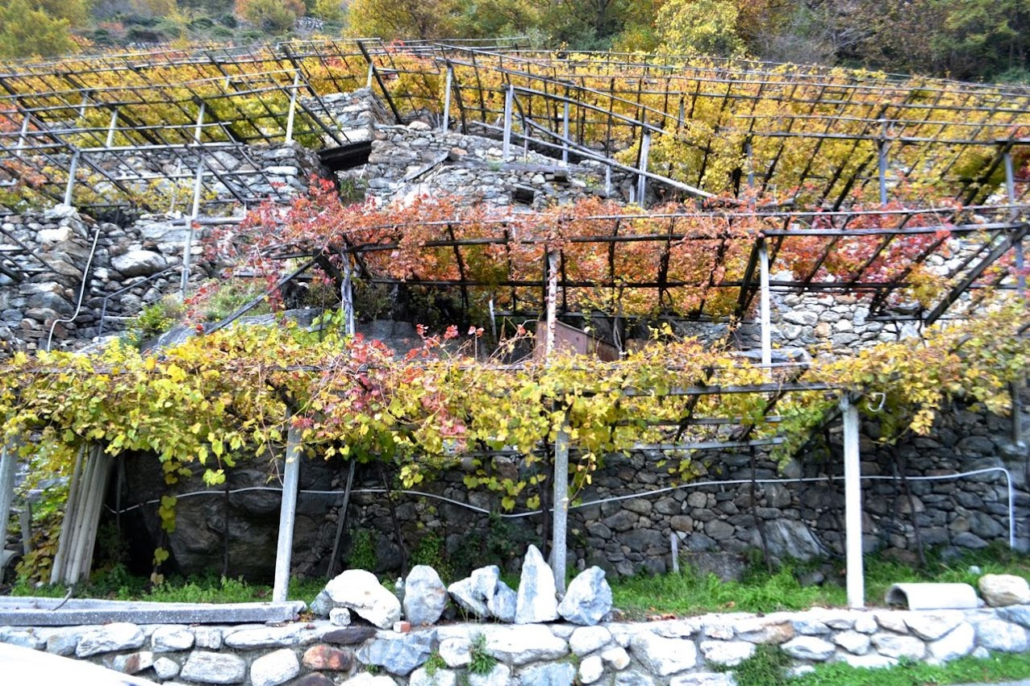
The granite-based vineyards of Caves de Donnas

Granite: 2018 Caves de Donnas Vallée d’Aoste Classico

The vines here in the far northwest of Italy grow on crazy-steep terraces of almost pure granite. Granite, along with the relatively high latitude and altitude of the vineyards around the town of Donnas, give acidity, minerality, and a brighter (even “crunchy”) quality to the fruit. Think less-ripe red fruit rather than dark cherries, with an alpine twang. Nebbiolo’s famous floral notes are a little more evident, and its darker, tarry qualities are less prominent. (For a simpler, more budget-friendly example from the region, try the 2020 Caves de Donnas Vallée d’Aoste – Barmet.)

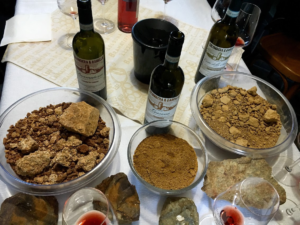
Volcanic sand: 2016 Colombera & Garella Bramaterra – Cascina Cottignano

The volcanic sand of Bramaterra (left); marine sand of Lessona (center)

Volcanic soils are a feature of much of the Alto Piemonte (but not all– compare the next wine). The Cascina Cottignano vineyard’s soil is iron-rich and therefore rusty-red decomposed volcanic sand. The volcanic part gives a darker quality to the minerality compared to granite, and the iron content adds a ferrous and even sanguine note to the fruit. Volcanic soils tend to be high in acidity, resulting in wines whose structure comes more from acidity than from tannin, certainly when compared with Barbaresco and Barolo.

Marine sand: 2018 Colombera & Garella Lessona – Pizzaguerra

The Pizzaguerra vineyard is just a mile from Cascina Cottignano, and yet the soils in the former are not volcanic at all, but rather sand from an ancient seabed. Marine sand (which is what we usually mean when we say “sandy soils”) gives elegance, perfume, and delicacy–less power, more prettiness.

Calcareous marl (limestone/clay): 2018 Produttori del Barbaresco Barbaresco

A combination of limestone and clay, sometimes with some sand in the mix, is the classic soil type found in both Barbaresco and Barolo in the Langhe. Like granite, limestone gives minerality, acidity, and freshness, but it also provides tannin and age-worthiness. Clay gives richer fruit, weight, and fullness. This combination of tannin and body makes for nebbiolos that are more powerful and imposing, compared with the other three terroirs described here.

If you’ve ever found yourself answering the question, “Well, what d’ya want?” with “Anything but chardonnay,” we’d like a word with you. First of all, come on: The West Coast is having a chardonnay renaissance. From Southern California’s Santa Rita Hills to Oregon’s Willamette Valley, there are a multitude of styles, with as many fresh and chiseled examples as there are oaked and rich. In California, growers keep pushing the vineyards into cooler, windier places that limit quick ripening, while the Oregon versions have their own unique characteristics. They’re worth revisiting. Really.

Yet, if you’re set on trying something different, you should try fiano. The fiano grape (fee-ah-no) is native to southern Italy, with Campania being the epicenter. The story goes like this: Romans named it Apianum, “loved by bees,” and bees aren’t dumb. Fiano tends towards small berries and intense but not plentiful juice. The smaller quantity means that quality needs to be high to justify the labor.
In southern Italy, the summers are just as warm as they are here, and there’s no issue getting grapes to ripen (as there often is at higher latitudes or elevations). The challenge is maintaining the natural acidity of the grapes in the resulting wine. Some grapes fare better than others in this respect. Chardonnay, for example, thrives in cool pockets, but it doesn’t hold its acidity if the days and nights are too warm. You can add acid during winemaking, but that’s a poor substitute for perfect fruit. (Imagine an overripe strawberry sprinkled with citric acid–it’s still overripe.)

Fiano, native to a warmer climate, holds its acidity well. As California winemakers come to terms with a warming climate (2023 being an exception so far), they’re naturally drawn to grapes with a history of making quality wine from warm locales. Because of fiano’s low yields, it’s not the grape that will make growers rich, but climate change helps tip the scale.

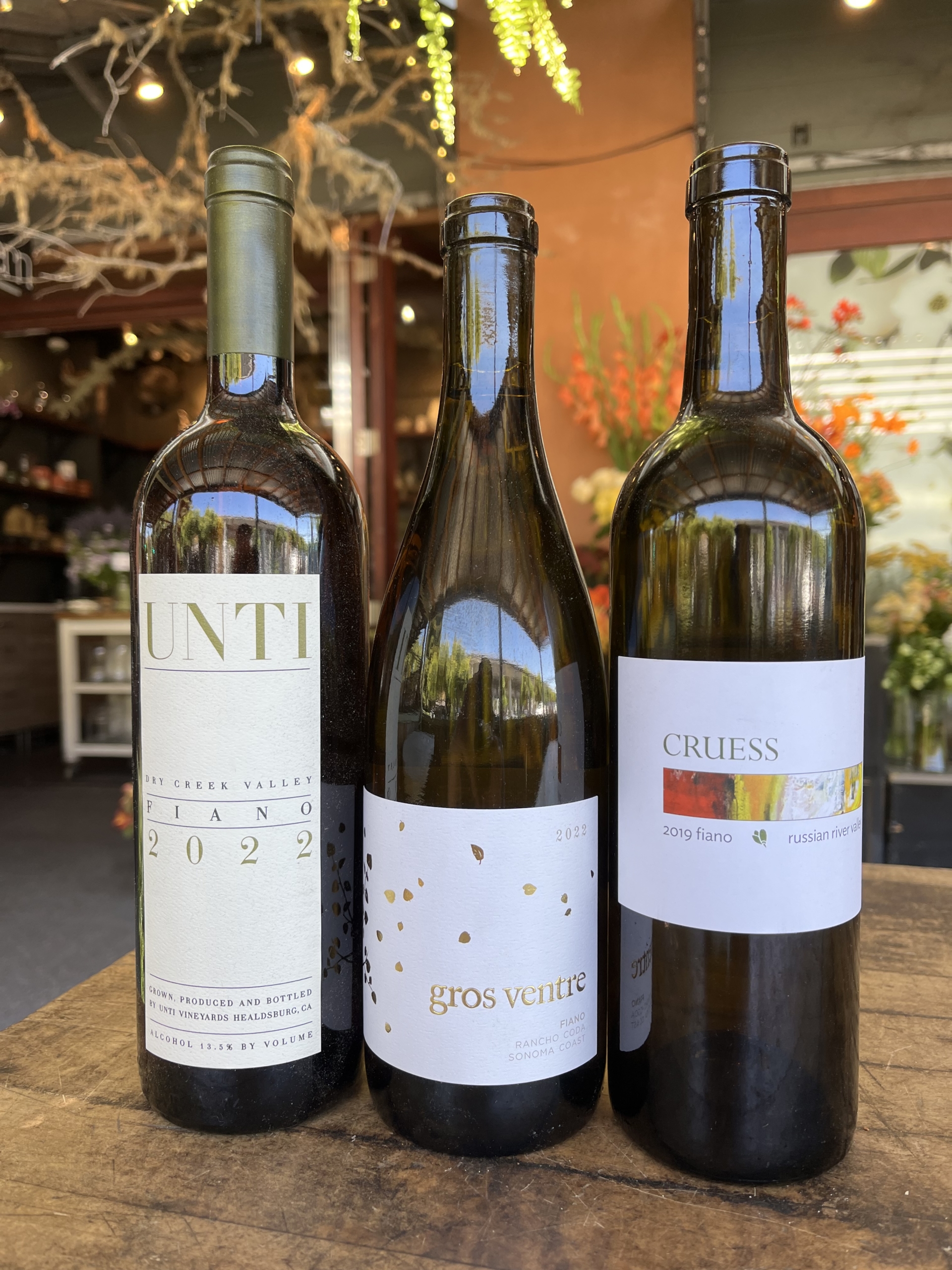
At Paul Marcus Wines, we of course feature a world-class selection of Fiano di Avellino (fiano from its Italian home turf), but we also offer a handful of fiano expressions from California’s Dry Creek and Russian River valleys. Unti was ahead of the trend in planting Italian varietals in California (or replanting, but that’s another story), and their success must have encouraged the others. Unti’s fiano (as well as their vermentino, for that matter) shows the brightness and intensity of carefully farmed grapes. Unfortunately, the grape’s reputation for low productivity is true even in California, and they make tiny quantities. Gros Ventre is making fiano from a younger vineyard a couple hillsides closer to the coast, which dials it back a notch and shows a classy refinement. Cruess is working a 1.5-acre vineyard and somehow producing affordable wine.

These California plantings of fiano aren’t on the volcanic soils that dominate Campania, so the wines lack that suggestion of burnt rock. In addition, these California examples of fiano haven’t been given the heavy winemaking hand that many chardonnays have; no one is using new oak barrels to flavor the wine. In truth, these producers are still trying to tease out what California fiano tastes like.

Naturally, it’s worth trying both types of fiano (Italian and Californian)  to experience what’s gained and lost by the different soil types. For a survey of Campania’s finest, you can turn to sleeker examples by I Favati and Guido Marsella or richer styles like Ciro Picariello. We also have higher-end versions such as the Quintodecimo and the I Favati Riserva that are suitable for longer aging.

When pairing with food, fiano can handle dishes with a bit more acid than chardonnay is comfy with, so go ahead and squeeze that lemon or add a splash more vinegar. Any of the rotisserie chickens at Market Hall Foods or a variety of glazed fish dishes would also be excellent matches.

All together, we’ve got enough fiano in the house to keep you busy exploring for weeks. Come on by, and we’ll help get you started on your fiano journey.

Named for a charismatic German Romantic poet, the Kerner grape is fast approaching its 100th anniversary. It was vine breeder August Herold who decided, in 1929, to cross the white grape riesling with the red grape trollinger (schiava). His goal was to produce a white grape that would flourish in colder climates. So pleased was he with the results that he named his new creation after local legend Justinus Kerner, a poet cum medicine man known for his magnetic personality.

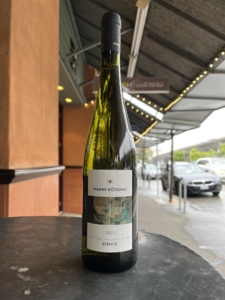
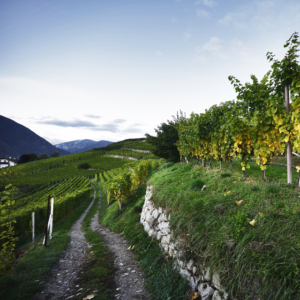
Despite its German roots, Kerner (the grape) seems to find its peak level in Italy’s far-northern Alto Adige region. For proof, look no further than the 2021 Manni Nössing Kerner – Südtirol Eisacktaler. The grapes for this aromatic and herbaceous gem come from steep, granite-heavy vineyards in the Valle Isarco (Eisacktaler in German), tucked among the Dolomites. Fermentation is mostly done in stainless steel, along with some acacia barrels, and the juice rests on the lees for a few months, adding a bit of texture.

Nössing’s hillside vineyards

Quite similar to riesling, Kerner is generally considered to be a bit less racy and a little softer and rounder than its parent grape. Although Kerner is often disparaged as a “heavy lifter”–known more for its high yields and durability rather than its excellence–Nössing’s version certainly flips the script. It offers vibrant, tangy, stone-fruit flavors and a whiff of Alpine wildflowers, buttressed by the ample acidity and mineral edge for which this region is known.

Among his many endeavors, Justinus Kerner also made his mark as a composer of drinking ditties. Wohlauf, noch getrunken, perhaps his most famous title, loosely translates as “well, looks like I’m still drunk.” No doubt ol’ Justinus Kerner would be proud of the work Manni Nössing does with his namesake grape. Nössing is, indeed, the “king of Kerner,” and whether you’re already a Kerner aficionado or you’re looking for a new discovery, Nössing’s Kerner is perhaps the finest example in the world.

If you have spent any time in our shop, you’ve probably noticed the superb wines of Fèlsina from the Castelnuovo Berardenga area of Chianti Classico. In fact, featuring these Tuscan beauties has become something of a tradition for us. (The card on the ever-present box of Chianti Classico now reads: “Excellent as Always.”) Our longstanding commitment to this esteemed producer has set forth a wonderful, mutually beneficial experience for us, our customers, and the winery.

Over the years, many of us at Paul Marcus Wines (and a number of you) have had the opportunity to visit Fèlsina, and we’ve become well acquainted with these great wines and the lovely people who work to create them. It really is an example of remarkable, dedicated people and an extraordinary place on Earth coming together to create something distinctive and magnificent.

In 1966, Domenico Poggiali acquired the estate and began a serious upgrading of farming and vineyard management. With the addition of Giuseppe Mazzocolin (a scholar of classics and history turned wine producer) in the late 1970s, the modern winery began to take shape, and by the mid-1980s, they were already producing some of Tuscany’s most memorable wines.

Giuseppe Mazzocolin

Located in the southernmost part of the Classico zone, Fèlsina is devoted to sangiovese, the area’s supreme grape, and to organic, environmentally responsible farming. They produce wines they believe to be the most Brunello-like of all Chianti. Indeed, these are some of the deepest and most age-worthy wines of Chianti Classico, celebrating the region’s singular earthy terroir, with dark fruits and anise and sandalwood spice notes.

Yet, these wines are so polished and elegant that they are enjoyable immediately, even the great Rancia Riserva. That said, I have had many old bottles of the Rancia, and they can be absolutely stunning, easily eclipsing probably 90 percent of Brunello on the market. And once you get a look at the site, you can understand how that is possible.

I have a fond memory of driving around with Giuseppe and stopping at a small dwelling at the top of the old, perfectly southwest-facing Rancia vineyard. It is breathtakingly beautiful and simply ideal for the sangiovese that thrives there. Mind you, Fèlsina uses only sangiovese for their Chianti Classico. (They believe, as I do, that cabernet and merlot take away much more than they give to sangiovese.) I asked Giuseppe how old the house is, and he said, “Well, I have papers back to 1400, so perhaps it’s older.”

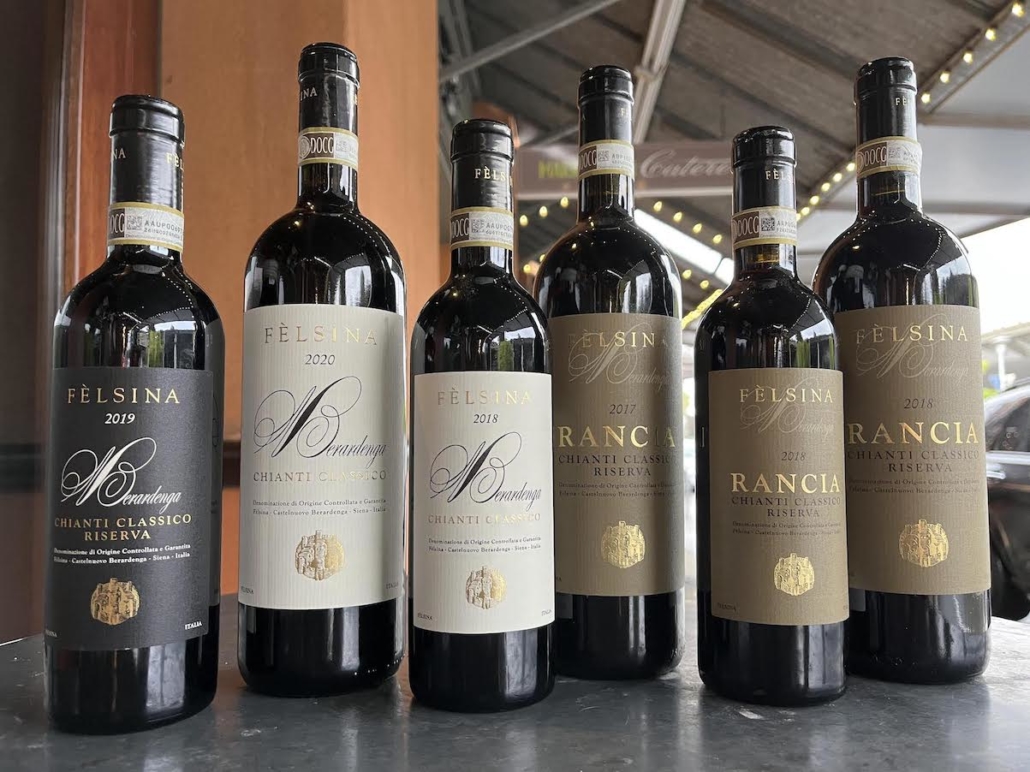
Currently, we offer a number of different Fèlsina wines from several vintages, in both standard and half bottles, including the 2017 and 2018 Rancia. Also noteworthy is the exceptional value of these wines–the flagship Chianti Classico is still less than $30, and the Berardenga Riserva is less than $40. And the Rancia Riserva, one of the world’s most enchanting wines, is $60 for the ’17 and $62 for the ’18–not exactly cheap, but rather reasonable when compared to the cost of a middling Burgundy, Bordeaux, or California cabernet.

The prized nebbiolo grape reaches its full potential in the powerful, complex, intense wines of Barolo and Barbaresco. There are occasions, however, when the humble drinker might prefer a style of nebbiolo that is more approachable (not to mention affordable). At Paul Marcus Wines, we offer several examples of nebbiolo that is lighter on its feet, versatile at the table, and more accessible in its youth.

For starters, check out the bright, supple, aromatic 2020 Paitin Langhe Nebbiolo ‘Starda.’ Located in the western Langhe village of Neive, just outside Barbaresco, Paitin has been producing their Langhe nebbiolo for 130 years. The grapes for this cuvee come from 40-year-old vines planted in sandy, lower-elevation soils. After a relatively long fermentation in stainless steel, the wine rests in old Slavonian barrels for up to a year. With vibrant red fruits and ample acidity, this high-toned nebbiolo will perfectly accompany, say, penne with pancetta and mushrooms in a vermouth cream sauce.

Next we head north to the Alto Piemonte and the 2018 Proprieta Sperino Coste della Sesia ‘Uvaggio.’ Based in Lessona, the Proprieta Sperino project began about 25 years ago, and their ‘Uvaggio’ cuvee is made from 80 percent nebbiolo rounded out by 15 percent vespolina and 5 percent croatina. This wine is a bit softer and more textured than the Paitin; it’s floral and spicy, with dense fruit and a distinct mineral edge. Try this one with pan-roasted pork tenderloin smothered in fresh herbs.

Finally, we return to the Langhe for the outstanding 2019 Cascina delle Rose Langhe Nebbiolo. The fruit for this lively, structured, and balanced bottling is all declassified Barbaresco from the famed Tre Stelle vineyard, and there is no wood used at any point in the production process; fermentation and aging all take place in stainless steel. The resulting wine is pure, elegant, and energetic, with a gorgeous nose and an almost Burgundian mouth feel. Make yourself a pot of orecchiette with sausage, brown butter, and sage, and you’ll be high-stepping into town!

Of course, Paul Marcus Wines also boasts an impressive array of world-class Barolo and Barbaresco if you’re looking for a special-occasion nebbiolo. To learn more about our wide-ranging nebbiolo selection, stop in and say hello. We’d all love to chat with you about one of our favorite grapes in the world.

A customer recently threw me for a loop. His brother, he said, insisted there was no reason to prefer “organic” wine because there was no Scientific Evidence that any effect on your health would ensue from doing so. This represents a basic and common misunderstanding. As was said in an Outer Limits episode many years ago: “Your ignorance makes me ill and angry.” Grrr.

Ferdinando Principiano overlooks his domain

I recently asked Ferdinando Principiano, a noted Piemonte producer, why he switched to organic practices 20 years ago. He had already shown us a native flower that had re-appeared on his property, and nowhere else, after 10 years of careful stewardship. He talked about the stream that he used to catch fish in as a boy that no longer supported fish and how determined he was to change that. And he also said there were days, when he finished spraying pesticides, that he would come home and throw up, not to mention the headaches and his trouble breathing.

*****

Not long ago, I spent the day at a friend’s house in Sonoma Valley. The property is bordered by an olive grove and a vineyard. It’s ridiculously nice. Bucolic. But he took me aside and said that sometimes, at 4 in the morning, he sees people in hazmat suits spray the vineyard. Not bucolic. (I wondered how much of the decision to spray at that time was concern over leaf burn and how much was “optics.”) Of course, in California, the owner of the vineyard hires laborers to do the dirty work, so he or she will never experience what Ferdinando personally experienced, and therefore, may never have a similar “aha moment.”

I don’t think it’s likely that the probably minute amounts of pesticide and herbicide and fungicide residue that transfer from “conventionally made” wine to the consumer would have an effect on a person’s health. At least not compared to the shrink-wrapped, processed meat we’re cooking on our Teflon skillets. (Add your own examples ad nauseam…) But that’s not the whole story.

*****

We asked Ferdinando why he doesn’t draw attention to his costly and labor-intensive farming on his wine labels. He said he didn’t want to say organic is good and conventional practices were bad because that would insult his parents. Because his parents had not practiced organic farming; because they couldn’t afford to. As we heard from many in the Langhe region in Italy, Ferdinando said his grandfather’s generation was really poor. Until very recently, grape growers had to sell their grapes to the highest bidder–and the bidding was rigged against them.

When you go fully organic, your yield per acre falls dramatically. (This is a serious and not romantic aspect of organics.) If you can’t get more money per ton of fruit, you’re simply slashing your income while increasing your labor. Being able to farm organically requires buyers who are willing to pay more for it. Ferdinando knows how lucky he is to live in a period where he can farm this way: “I have this good fortune, and I must do something to merit it.”

There are so many farmers like Ferdinando–in Italy, in America, everywhere–that want to farm without the chemicals that require hazmat suits, that want their kids to be able to safely eat the fruit and sniff the flowers in their backyard vineyards, and we live in a time where they can.