As the great Merle Haggard used to sing, “If we make it through December, everything’s gonna be all right I know.” Whether you’re cooking, entertaining, traveling, relaxing, or partying, the folks at Paul Marcus Wines have some advice to help you navigate the holiday season. The bottles mentioned below will hopefully bring you joy and serenity, two things we all need as the calendar turns to another year.
“If we make it through December, we’ll be fine.”
 Burgundy’s Best
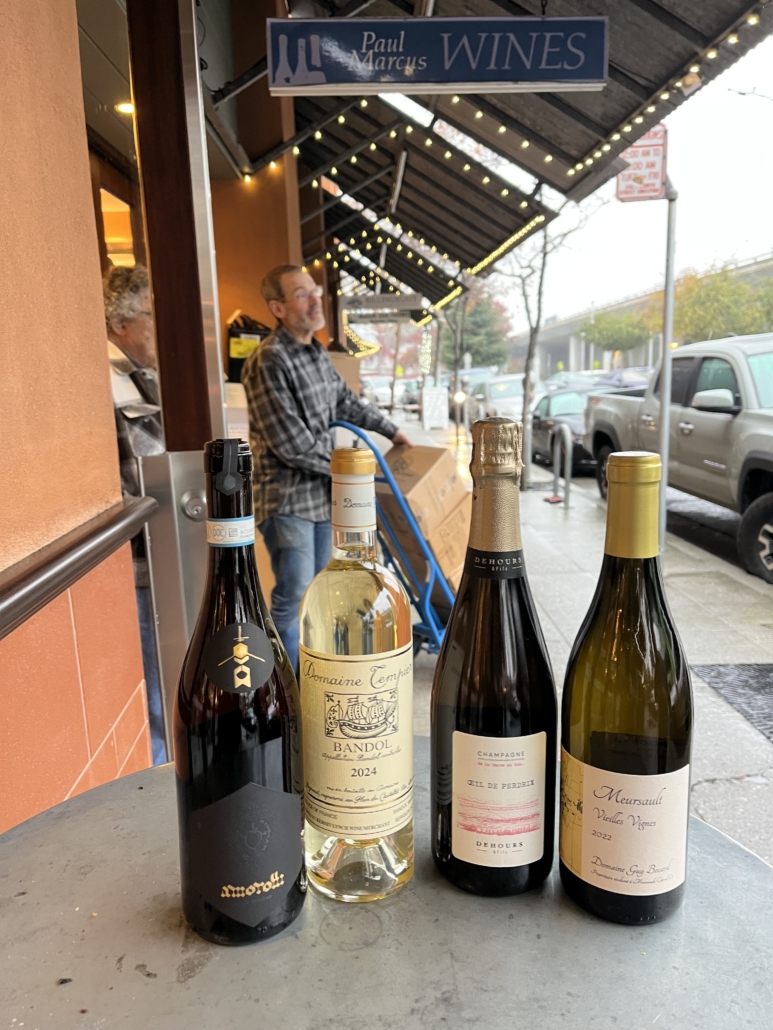
The 2022 Guy Bocard Meursault VV is a special wine because it represents the pinnacle of chardonnay from Burgundy. As Meursault should, it is opulent with a layered, luxurious texture, vibrant acidity, and proper tension. The vines are more than 50 years old grown on parcels with clay-limestone soils and southeastern exposure. It is aged 18 months on the lees—12 months in French oak barrels plus six months in stainless-steel vats. This stellar wine is rich, creamy, and buttery, with flavors of hazelnut and almond; it’s concentrated, precise, and fresh. Enjoy with seafood, chicken, turkey, mushroom cream sauce, and soft creamy cheeses.
— Paul Marcus
Fuel for the Journey
The American Road Trip—a grand highway of gas stations, scenic lookouts, and truck stops—could be said to hold similar virtues and possible pitfalls as the American holiday table; a well-planned trip like a well-appointed table is marked by both tradition and newness. Family and friends fill the seats and are the true centerpiece of both outings.
But do we have to drive an American car or drink American wine? You can, and they often work well, but in the spirit of international collaboration, I recommend the following wines for your table this year. (And because I think that turkey is a JV main course, it surely needs some help from gravy—and-wine.)
Standing, Chatting, and Cooking:
2024 Domaine Tempier Bandol Blanc
Serve chilled. Crisp yet with enough viscosity to marry the turkey and the potatoes, who, let’s face it, are an item. A fabulous, aromatically complex wine that is one of the very best wines in the region.
At the Table, to Start:
NV Hure Freres Champagne ‘Invitation’
Serve cold in regular wine glasses. A crisp, balanced glass of Champagne can go with anything. This has the luscious toasty notes but with a curved spine of bright citric acid that carries the ripe fruit forward. An amazing glass.
and/or
2023 AT Roca Reserva Rosat Cava
Serve cold in regular wine glasses. I would serve this after the Hure Freres as it is a rosé. From the Penedes near Barcelona, this wine is made Méthode Champenoise. Crisp and very dry. Got oysters?
At the Table, to Continue:
2024 Domaine Tempier Bandol Blanc Redux (for those who want white wine with the main)
and
2022 Amorotti, Cerasuolo d’Abruzzo (Brâncuși’s Prometheus in twilight)
Serve chilled. Currently my favorite wine in the shop, exciting and complex and immensely drinkable. Biodynamic and organic and, for me, the best Cerasuolo in Italy. Best if you think about it… and should only be made in magnum.
— Chad Arnold
Hitting the Mark
It comes as no big surprise that I choose to highlight a Champagne. While there are many wonderful sparkling wines on our shelves, there’s nothing that quite hits the mark like Champagne. But even within this category, there are wines that truly stand apart. We may not “need” them, but they are often the ones we are most excited to share with you. Enter: L’Oeil de Perdrix (aka The Partridge’s Eye).
L’Oeil de Perdrix, the unusual name for the palest pink wines of Champagne, dates back to the Middle Ages. Let’s take a step back in time to the early days of Champagne, back when the climate was far cooler, and before the development of trapping bubbles on purpose during bottle conditioning. In this era, winemakers competed with other warmer regions (namely, Burgundy) to make quality red and white still wines.
In an attempt to bolster the flavors of their white wines, winemakers tried crafting blanc de noir (white wine of red grapes). However, with the limited technology at the time, any attempt to direct-press red grapes still resulted in pale pink wines—as pink as the center of a partridge’s eye. Modernization and technological improvements resulted in clearer, whiter pressed juice and led to the decline of this unique wine made in Champagne.
These days, very few winemakers carry on this tradition (likely to be found in northwest Switzerland of all places), and even fewer who do so in Champagne. However, Jerome Dehours has revived and celebrated this tradition of light pink wines—only this time, with bubbles! Jerome organically farms 42 different vineyards that amount to a mere 14.5 hectares across three villages in the Marne Valley. The majority of his parcels (about 70 percent) are pinot meunier, a grape particularly well suited to this delicate style. This wine is mostly meunier (74 percent) and some chardonnay (16 percent) with a touch of reserve wine (10 percent). The wine is fermented in stainless steel and only the barest touch of dosage is added; both elements allow the meunier fruit to shine.
And the flavors abound! For such a subtle wine, there is an excess of character. Fruits of crunchy cranberry and juicy orange zest blend with textured dried flowers, red tea, and the slightest hint of spices. The palate matches the aroma and is just as nuanced; the fruit shines with delightfully lean, silky bubbles and refreshingly bright acidity that carries the flavors across the long, elegant finish.
— Ailis Peplau
From Tuscany to Table
For me, sangiovese is one of the most versatile and enjoyable varieties in the world, a good match with a wide range of cuisine from lighter fare to richer meat and poultry dishes. In particular, this is true of wines from Tuscany’s Chianti Classico region. With all of the diverse and contrasting foods that appear on most of our holiday tables, Chianti Classico can be a great choice. Along with a number of old favorites, we have several new, exciting items from the region to offer.
First, I would like to focus on the tiny six-hectare estate of Tregole, whose very high-altitude (over 500 meters) vineyards are located in the northern part of the Castellina zone overlooking Radda. The estate is overseen by the owner and winemaker Sophie Conte. The viticulture is organic, and the wines are made from 100 percent sangiovese grapes. The 2022 Tregole Chianti Classico is a very pure, generous, yet elegant wine—very expressive and open already, with gentle tannins. And it’s a tremendous value to boot. Highly recommended.
If you want to dial it up a bit and see how Chianti Classico can be every bit as great as Brunello di Montalcino, I suggest you check out these new offerings that receive the Gran Selezione designation, intended to be seen as a step above Riserva.
The gorgeous, mid-weight 2019 Terreno Chianti Classico Gran Selezione ‘Sillano’ offers beautiful cherry notes and has enough bottle age to show some secondary flavors with very smooth tannins.
The 2020 Castello di Ama Gran Selezione ‘San Lorenzo’ is a fuller, darker, plush, and polished Gran Selezione. This wine has such a concentrated and intense feel that you might think it would be quite tannic, but it isn’t. It drinks beautifully now and, like the Terreno, comes in at a relatively low 13.5 percent alcohol.
The ripest and biggest of the three is the 2020 Le Cinciole Gran Selezione ‘Aluigi’—it’s full, rich, long, and layered, but still a wine that drinks beautifully already and does not come across as heavy-handed. Emilia, Mark, and I recently had the pleasure of sharing a meal and tasting some older wines with Valeria and her daughter Veena from the estate. We tasted a 2011 and a 2010 and were astonished by how fresh and youthful the wines remain. We all thought they tasted like they were about five years younger.
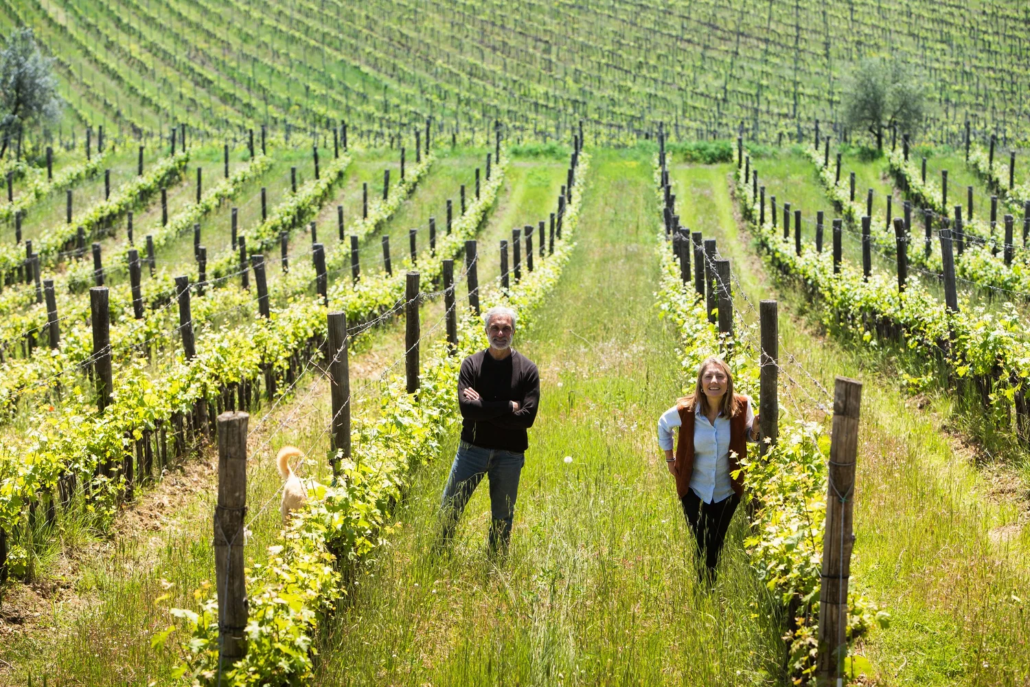
Luca and Valeria in Le Cinciole vineyards
Many people may not realize how long and beautifully Chianti Classico can age, especially for a wine that does not start out as severely tannic. The Le Cinciole wines provided great examples of how gracefully they can evolve. The solution, of course, is to drink a couple of bottles while they are young and lay down a few for the future.
— Joel Mullennix
Chill Out
Since long before “chillable red” became a go-to category, a year-round refreshment, and even a section in the PMW wine fridge, Hungary and adjacent Central European countries have been making Siller (pronounced “SHILL-er”). The 2024 Heimann & Fiai Szekszárd Siller ‘Piros,’ Zoltán and Zoltán Jr. Heimann’s version, is two-thirds blaufränkisch with no maceration and one-third kadarka with short maceration. The result is a wine that dances on the boundary of dark rosé and light red—spicy and freshissimo and ready to get chill(ed)—even in December.
— Mark Middlebrook