As the great Merle Haggard used to sing, “If we make it through December, everything’s gonna be all right I know.” Whether you’re cooking, entertaining, traveling, relaxing, or partying, the folks at Paul Marcus Wines have some advice to help you navigate the holiday season. The bottles mentioned below will hopefully bring you joy and serenity, two things we all need as the calendar turns to another year.
“If we make it through December, we’ll be fine.”
 Burgundy’s Best
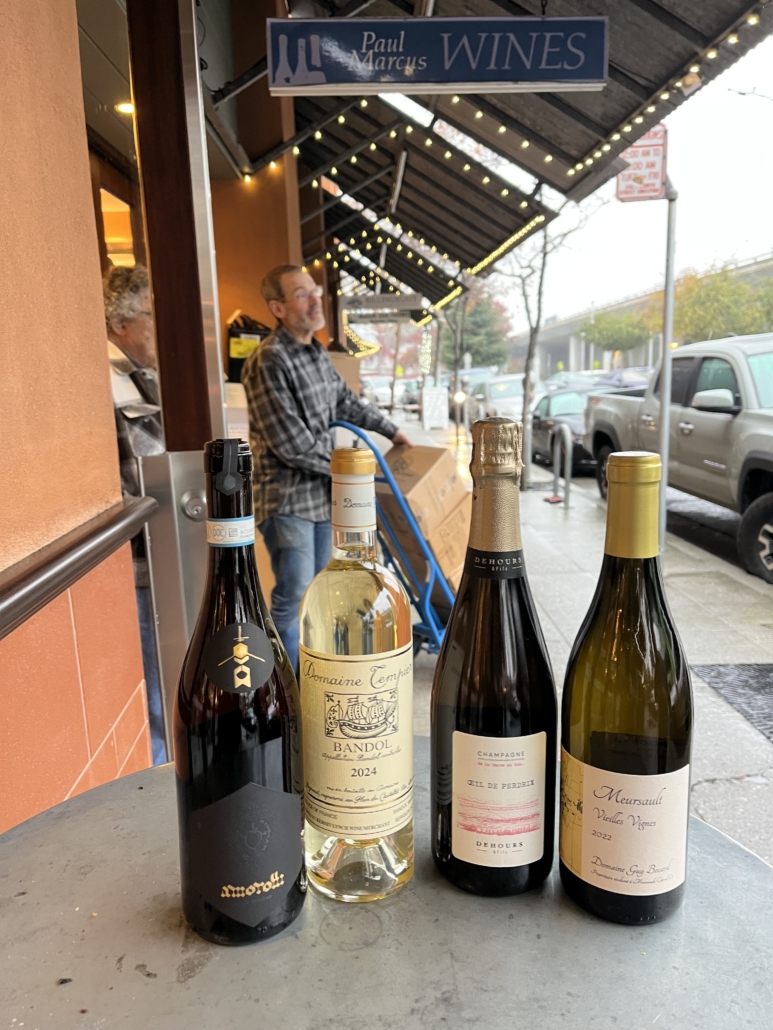
The 2022 Guy Bocard Meursault VV is a special wine because it represents the pinnacle of chardonnay from Burgundy. As Meursault should, it is opulent with a layered, luxurious texture, vibrant acidity, and proper tension. The vines are more than 50 years old grown on parcels with clay-limestone soils and southeastern exposure. It is aged 18 months on the lees—12 months in French oak barrels plus six months in stainless-steel vats. This stellar wine is rich, creamy, and buttery, with flavors of hazelnut and almond; it’s concentrated, precise, and fresh. Enjoy with seafood, chicken, turkey, mushroom cream sauce, and soft creamy cheeses.
— Paul Marcus
Fuel for the Journey
The American Road Trip—a grand highway of gas stations, scenic lookouts, and truck stops—could be said to hold similar virtues and possible pitfalls as the American holiday table; a well-planned trip like a well-appointed table is marked by both tradition and newness. Family and friends fill the seats and are the true centerpiece of both outings.
But do we have to drive an American car or drink American wine? You can, and they often work well, but in the spirit of international collaboration, I recommend the following wines for your table this year. (And because I think that turkey is a JV main course, it surely needs some help from gravy—and-wine.)
Standing, Chatting, and Cooking:
2024 Domaine Tempier Bandol Blanc
Serve chilled. Crisp yet with enough viscosity to marry the turkey and the potatoes, who, let’s face it, are an item. A fabulous, aromatically complex wine that is one of the very best wines in the region.
At the Table, to Start:
NV Hure Freres Champagne ‘Invitation’
Serve cold in regular wine glasses. A crisp, balanced glass of Champagne can go with anything. This has the luscious toasty notes but with a curved spine of bright citric acid that carries the ripe fruit forward. An amazing glass.
and/or
2023 AT Roca Reserva Rosat Cava
Serve cold in regular wine glasses. I would serve this after the Hure Freres as it is a rosé. From the Penedes near Barcelona, this wine is made Méthode Champenoise. Crisp and very dry. Got oysters?
At the Table, to Continue:
2024 Domaine Tempier Bandol Blanc Redux (for those who want white wine with the main)
and
2022 Amorotti, Cerasuolo d’Abruzzo (Brâncuși’s Prometheus in twilight)
Serve chilled. Currently my favorite wine in the shop, exciting and complex and immensely drinkable. Biodynamic and organic and, for me, the best Cerasuolo in Italy. Best if you think about it… and should only be made in magnum.
— Chad Arnold
Hitting the Mark
It comes as no big surprise that I choose to highlight a Champagne. While there are many wonderful sparkling wines on our shelves, there’s nothing that quite hits the mark like Champagne. But even within this category, there are wines that truly stand apart. We may not “need” them, but they are often the ones we are most excited to share with you. Enter: L’Oeil de Perdrix (aka The Partridge’s Eye).
L’Oeil de Perdrix, the unusual name for the palest pink wines of Champagne, dates back to the Middle Ages. Let’s take a step back in time to the early days of Champagne, back when the climate was far cooler, and before the development of trapping bubbles on purpose during bottle conditioning. In this era, winemakers competed with other warmer regions (namely, Burgundy) to make quality red and white still wines.
In an attempt to bolster the flavors of their white wines, winemakers tried crafting blanc de noir (white wine of red grapes). However, with the limited technology at the time, any attempt to direct-press red grapes still resulted in pale pink wines—as pink as the center of a partridge’s eye. Modernization and technological improvements resulted in clearer, whiter pressed juice and led to the decline of this unique wine made in Champagne.
These days, very few winemakers carry on this tradition (likely to be found in northwest Switzerland of all places), and even fewer who do so in Champagne. However, Jerome Dehours has revived and celebrated this tradition of light pink wines—only this time, with bubbles! Jerome organically farms 42 different vineyards that amount to a mere 14.5 hectares across three villages in the Marne Valley. The majority of his parcels (about 70 percent) are pinot meunier, a grape particularly well suited to this delicate style. This wine is mostly meunier (74 percent) and some chardonnay (16 percent) with a touch of reserve wine (10 percent). The wine is fermented in stainless steel and only the barest touch of dosage is added; both elements allow the meunier fruit to shine.
And the flavors abound! For such a subtle wine, there is an excess of character. Fruits of crunchy cranberry and juicy orange zest blend with textured dried flowers, red tea, and the slightest hint of spices. The palate matches the aroma and is just as nuanced; the fruit shines with delightfully lean, silky bubbles and refreshingly bright acidity that carries the flavors across the long, elegant finish.
— Ailis Peplau
From Tuscany to Table
For me, sangiovese is one of the most versatile and enjoyable varieties in the world, a good match with a wide range of cuisine from lighter fare to richer meat and poultry dishes. In particular, this is true of wines from Tuscany’s Chianti Classico region. With all of the diverse and contrasting foods that appear on most of our holiday tables, Chianti Classico can be a great choice. Along with a number of old favorites, we have several new, exciting items from the region to offer.
First, I would like to focus on the tiny six-hectare estate of Tregole, whose very high-altitude (over 500 meters) vineyards are located in the northern part of the Castellina zone overlooking Radda. The estate is overseen by the owner and winemaker Sophie Conte. The viticulture is organic, and the wines are made from 100 percent sangiovese grapes. The 2022 Tregole Chianti Classico is a very pure, generous, yet elegant wine—very expressive and open already, with gentle tannins. And it’s a tremendous value to boot. Highly recommended.
If you want to dial it up a bit and see how Chianti Classico can be every bit as great as Brunello di Montalcino, I suggest you check out these new offerings that receive the Gran Selezione designation, intended to be seen as a step above Riserva.
The gorgeous, mid-weight 2019 Terreno Chianti Classico Gran Selezione ‘Sillano’ offers beautiful cherry notes and has enough bottle age to show some secondary flavors with very smooth tannins.
The 2020 Castello di Ama Gran Selezione ‘San Lorenzo’ is a fuller, darker, plush, and polished Gran Selezione. This wine has such a concentrated and intense feel that you might think it would be quite tannic, but it isn’t. It drinks beautifully now and, like the Terreno, comes in at a relatively low 13.5 percent alcohol.
The ripest and biggest of the three is the 2020 Le Cinciole Gran Selezione ‘Aluigi’—it’s full, rich, long, and layered, but still a wine that drinks beautifully already and does not come across as heavy-handed. Emilia, Mark, and I recently had the pleasure of sharing a meal and tasting some older wines with Valeria and her daughter Veena from the estate. We tasted a 2011 and a 2010 and were astonished by how fresh and youthful the wines remain. We all thought they tasted like they were about five years younger.
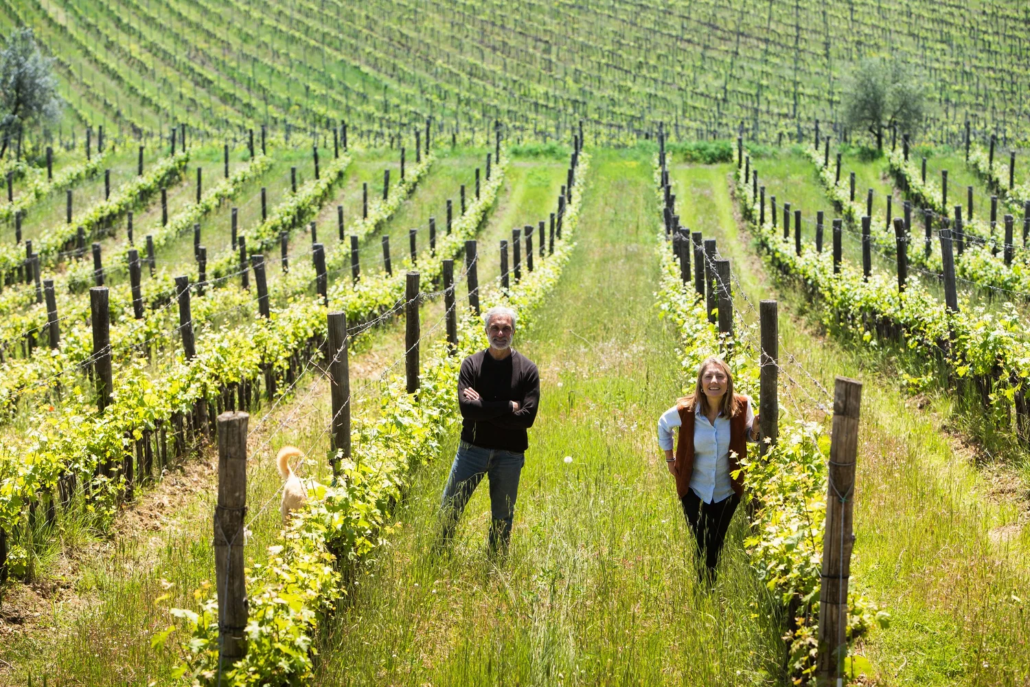
Luca and Valeria in Le Cinciole vineyards
Many people may not realize how long and beautifully Chianti Classico can age, especially for a wine that does not start out as severely tannic. The Le Cinciole wines provided great examples of how gracefully they can evolve. The solution, of course, is to drink a couple of bottles while they are young and lay down a few for the future.
— Joel Mullennix
Chill Out
Since long before “chillable red” became a go-to category, a year-round refreshment, and even a section in the PMW wine fridge, Hungary and adjacent Central European countries have been making Siller (pronounced “SHILL-er”). The 2024 Heimann & Fiai Szekszárd Siller ‘Piros,’ Zoltán and Zoltán Jr. Heimann’s version, is two-thirds blaufränkisch with no maceration and one-third kadarka with short maceration. The result is a wine that dances on the boundary of dark rosé and light red—spicy and freshissimo and ready to get chill(ed)—even in December.
— Mark Middlebrook
Celebrating Holidays: How to Make It Through December
Holidays, UncategorizedAs the great Merle Haggard used to sing, “If we make it through December, everything’s gonna be all right I know.” Whether you’re cooking, entertaining, traveling, relaxing, or partying, the folks at Paul Marcus Wines have some advice to help you navigate the holiday season. The bottles mentioned below will hopefully bring you joy and serenity, two things we all need as the calendar turns to another year.
“If we make it through December, we’ll be fine.”
The 2022 Guy Bocard Meursault VV is a special wine because it represents the pinnacle of chardonnay from Burgundy. As Meursault should, it is opulent with a layered, luxurious texture, vibrant acidity, and proper tension. The vines are more than 50 years old grown on parcels with clay-limestone soils and southeastern exposure. It is aged 18 months on the lees—12 months in French oak barrels plus six months in stainless-steel vats. This stellar wine is rich, creamy, and buttery, with flavors of hazelnut and almond; it’s concentrated, precise, and fresh. Enjoy with seafood, chicken, turkey, mushroom cream sauce, and soft creamy cheeses.
— Paul Marcus
Fuel for the Journey
The American Road Trip—a grand highway of gas stations, scenic lookouts, and truck stops—could be said to hold similar virtues and possible pitfalls as the American holiday table; a well-planned trip like a well-appointed table is marked by both tradition and newness. Family and friends fill the seats and are the true centerpiece of both outings.
But do we have to drive an American car or drink American wine? You can, and they often work well, but in the spirit of international collaboration, I recommend the following wines for your table this year. (And because I think that turkey is a JV main course, it surely needs some help from gravy—and-wine.)
Standing, Chatting, and Cooking:
2024 Domaine Tempier Bandol Blanc
Serve chilled. Crisp yet with enough viscosity to marry the turkey and the potatoes, who, let’s face it, are an item. A fabulous, aromatically complex wine that is one of the very best wines in the region.
At the Table, to Start:
NV Hure Freres Champagne ‘Invitation’
Serve cold in regular wine glasses. A crisp, balanced glass of Champagne can go with anything. This has the luscious toasty notes but with a curved spine of bright citric acid that carries the ripe fruit forward. An amazing glass.
and/or
2023 AT Roca Reserva Rosat Cava
Serve cold in regular wine glasses. I would serve this after the Hure Freres as it is a rosé. From the Penedes near Barcelona, this wine is made Méthode Champenoise. Crisp and very dry. Got oysters?
At the Table, to Continue:
2024 Domaine Tempier Bandol Blanc Redux (for those who want white wine with the main)
and
2022 Amorotti, Cerasuolo d’Abruzzo (Brâncuși’s Prometheus in twilight)
Serve chilled. Currently my favorite wine in the shop, exciting and complex and immensely drinkable. Biodynamic and organic and, for me, the best Cerasuolo in Italy. Best if you think about it… and should only be made in magnum.
— Chad Arnold
Hitting the Mark
It comes as no big surprise that I choose to highlight a Champagne. While there are many wonderful sparkling wines on our shelves, there’s nothing that quite hits the mark like Champagne. But even within this category, there are wines that truly stand apart. We may not “need” them, but they are often the ones we are most excited to share with you. Enter: L’Oeil de Perdrix (aka The Partridge’s Eye).
L’Oeil de Perdrix, the unusual name for the palest pink wines of Champagne, dates back to the Middle Ages. Let’s take a step back in time to the early days of Champagne, back when the climate was far cooler, and before the development of trapping bubbles on purpose during bottle conditioning. In this era, winemakers competed with other warmer regions (namely, Burgundy) to make quality red and white still wines.
In an attempt to bolster the flavors of their white wines, winemakers tried crafting blanc de noir (white wine of red grapes). However, with the limited technology at the time, any attempt to direct-press red grapes still resulted in pale pink wines—as pink as the center of a partridge’s eye. Modernization and technological improvements resulted in clearer, whiter pressed juice and led to the decline of this unique wine made in Champagne.
These days, very few winemakers carry on this tradition (likely to be found in northwest Switzerland of all places), and even fewer who do so in Champagne. However, Jerome Dehours has revived and celebrated this tradition of light pink wines—only this time, with bubbles! Jerome organically farms 42 different vineyards that amount to a mere 14.5 hectares across three villages in the Marne Valley. The majority of his parcels (about 70 percent) are pinot meunier, a grape particularly well suited to this delicate style. This wine is mostly meunier (74 percent) and some chardonnay (16 percent) with a touch of reserve wine (10 percent). The wine is fermented in stainless steel and only the barest touch of dosage is added; both elements allow the meunier fruit to shine.
And the flavors abound! For such a subtle wine, there is an excess of character. Fruits of crunchy cranberry and juicy orange zest blend with textured dried flowers, red tea, and the slightest hint of spices. The palate matches the aroma and is just as nuanced; the fruit shines with delightfully lean, silky bubbles and refreshingly bright acidity that carries the flavors across the long, elegant finish.
— Ailis Peplau
From Tuscany to Table
For me, sangiovese is one of the most versatile and enjoyable varieties in the world, a good match with a wide range of cuisine from lighter fare to richer meat and poultry dishes. In particular, this is true of wines from Tuscany’s Chianti Classico region. With all of the diverse and contrasting foods that appear on most of our holiday tables, Chianti Classico can be a great choice. Along with a number of old favorites, we have several new, exciting items from the region to offer.
First, I would like to focus on the tiny six-hectare estate of Tregole, whose very high-altitude (over 500 meters) vineyards are located in the northern part of the Castellina zone overlooking Radda. The estate is overseen by the owner and winemaker Sophie Conte. The viticulture is organic, and the wines are made from 100 percent sangiovese grapes. The 2022 Tregole Chianti Classico is a very pure, generous, yet elegant wine—very expressive and open already, with gentle tannins. And it’s a tremendous value to boot. Highly recommended.
If you want to dial it up a bit and see how Chianti Classico can be every bit as great as Brunello di Montalcino, I suggest you check out these new offerings that receive the Gran Selezione designation, intended to be seen as a step above Riserva.
The gorgeous, mid-weight 2019 Terreno Chianti Classico Gran Selezione ‘Sillano’ offers beautiful cherry notes and has enough bottle age to show some secondary flavors with very smooth tannins.
The 2020 Castello di Ama Gran Selezione ‘San Lorenzo’ is a fuller, darker, plush, and polished Gran Selezione. This wine has such a concentrated and intense feel that you might think it would be quite tannic, but it isn’t. It drinks beautifully now and, like the Terreno, comes in at a relatively low 13.5 percent alcohol.
The ripest and biggest of the three is the 2020 Le Cinciole Gran Selezione ‘Aluigi’—it’s full, rich, long, and layered, but still a wine that drinks beautifully already and does not come across as heavy-handed. Emilia, Mark, and I recently had the pleasure of sharing a meal and tasting some older wines with Valeria and her daughter Veena from the estate. We tasted a 2011 and a 2010 and were astonished by how fresh and youthful the wines remain. We all thought they tasted like they were about five years younger.
Luca and Valeria in Le Cinciole vineyards
Many people may not realize how long and beautifully Chianti Classico can age, especially for a wine that does not start out as severely tannic. The Le Cinciole wines provided great examples of how gracefully they can evolve. The solution, of course, is to drink a couple of bottles while they are young and lay down a few for the future.
— Joel Mullennix
Chill Out
Since long before “chillable red” became a go-to category, a year-round refreshment, and even a section in the PMW wine fridge, Hungary and adjacent Central European countries have been making Siller (pronounced “SHILL-er”). The 2024 Heimann & Fiai Szekszárd Siller ‘Piros,’ Zoltán and Zoltán Jr. Heimann’s version, is two-thirds blaufränkisch with no maceration and one-third kadarka with short maceration. The result is a wine that dances on the boundary of dark rosé and light red—spicy and freshissimo and ready to get chill(ed)—even in December.
— Mark Middlebrook
Regional Roundup: Three (or Four) Appellations You Should Know
California, France, Holidays, ItalyCerasuolo d’Abruzzo—Pairs Well with Thanksgiving and Sonny & Cher’s All I Ever Need Is You
Made with the montepulciano grape, Cerasuolo means “cherry-red” or “cherry-like,” referencing both the color and general flavor profile of the wine. This magenta-hued rosé, which sometimes poses as a very light, slightly tannic red, is a chameleon—it goes with almost anything. With the Thanksgiving spread being both a predictable and unpredictable myriad of sweet, salty, herby, and tangy, this wine is so incredibly versatile that it will adapt to almost any bite. The marshmallow-on-top is that it’s simply and unequivocally delicious and is sure to please whoever takes a sip.
At Paul Marcus Wines, there is unanimous consensus among buyers and staff that Cerasuolo d’Abruzzo rocks our socks—so much so we often carry multiple options from different producers. We think the three detailed below drink ultra tasty, yet differently enough that they all deserve a place on your table for the Thanksgiving holiday (and, frankly, year-round).
Cerasuolo, All I Ever Need Is You.
Torre dei Beati
Torre dei Beati’s next-door neighbor is arguably the most famous wine grower in Abruzzo—Eduardo Valentini. If you can even find a bottle of Valentini, you’ll be lucky if you spend less than $200. Torre dei Beati offers a range of classic Abruzzese wines from the same terroir for far less. Montepulciano is so vigorous that it can (and often is) boring or flabby—hence our association with a generic table wine. But when yields are curbed, along with organic and intentional grape growing in this grand-cru area of Loreto Aprutino, the difference is uncanny.
The estate is certified organic, and the combination of elevation and clay-limestone soils ensures delicacy and elegance—in addition to careful farming, limited yields, and minimal cellar tinkering. The final wine is a result of saignée, blanc de noir, and maceration, all blended into one dynamic wine. You’ll find cherry Jolly Rancher, blood orange, grapefruit, saline minerality, and deep, complex, nuanced hints of lavender and rose.
Tiberio
Azienda Agricola Tiberio had late beginnings, at least when you compare their story and trajectory to historic and family-crested cantine (wineries). About 25 years ago, Riccardo Tiberio jumped at the opportunity to purchase eight hectares of old-vine Trebbiano Abruzzese, understanding the grape’s potential (the same grape that brought widespread acclaim to Valentini). In 2008, his children Cristiana and Antonio took over. Cristiana is a chemist by trade, and she approaches her winemaking with the same methodical curiosity, while Riccardo spends his days in the vineyards.
This Cerasuolo is true to the Abruzzese tradition in that it is rich and dark. The tannin is surprisingly soft considering how dark the wine is, but it’s still a wine that will hold up through your entire meal. With notes of red cherry, petrichor, sage, and antique rose, it is soft and round.
Amorotti
Amorotti is a young winery that has deep roots in the farming history of Abruzzo. It is run by Gaetano Carboni, a lawyer who chose to dedicate himself to his family farm instead of practicing law. (Amorotti is the maiden name of Carboni’s mother.) In 1905, his grandfather was the first Italian extra-virgin olive oil producer to export to the U.S. Today, the family runs an olive oil museum in an ancient castle in the heart of the central Abruzzo town of Loreto Aprutino, displaying old production methods, vintage pictures, and tools.
The vineyards have belonged to the Amorotti/Carboni family for more than a century, and the wine is produced in the same cavernous cellar that the family has always used for their personal consumption. In 1992, Gaetano refurbished the cellar, and a few years later, he started uprooting old vines to plant new stock. Only recently did he decide to start bottling the best grapes they harvest, and the 2016 vintage was his first release. Carboni also continues to produce olive oil to this day, and together with his wife, he runs an agriturismo with a focus on contemporary art where they host a series of artists-in-residence programs. The entire property is certified organic.
Amorotti’s Cerasuolo is intentionally more serious and age-worthy than the other two. It is more reductive and flinty, and amongst wine pros is compared to the big names of Abruzzo: Valentini and Emidio Pepe. Pleasant smoky reduction dissipates to reveal dried sage, wild strawberries, stone dust, and violet, with salty minerals to balance. Crisp wild berry and blood orange complete the picture.
All these Cerasuolo selections use organic grapes and apply minimal intervention in the cellar, with only native yeast and spontaneous fermentation. Some might use the term “natural” to describe these methods. However, these wines are not “natty” and display no flaws. (Yes, it is possible to drink natural wine that doesn’t taste like burning manure.)
These Cerasuoli will make a convert out of you, whether you swing natty or not. If you’d like to sample them all, we are currently offering a 15 percent discount on our Cerasuolo three-pack. So bust out the Sonny & Cher, and learn more about this fascinating DOC.
— Emilia Aiello
California Cool—Restraint in the Golden State
The Turkey Day table is often such a super abundance of foods that you must go basic when pairing wine. How do we survive this? Our advice is always the same—drink what makes you happy. But for those who believe a national holiday deserves a national drink, we offer some suggestions.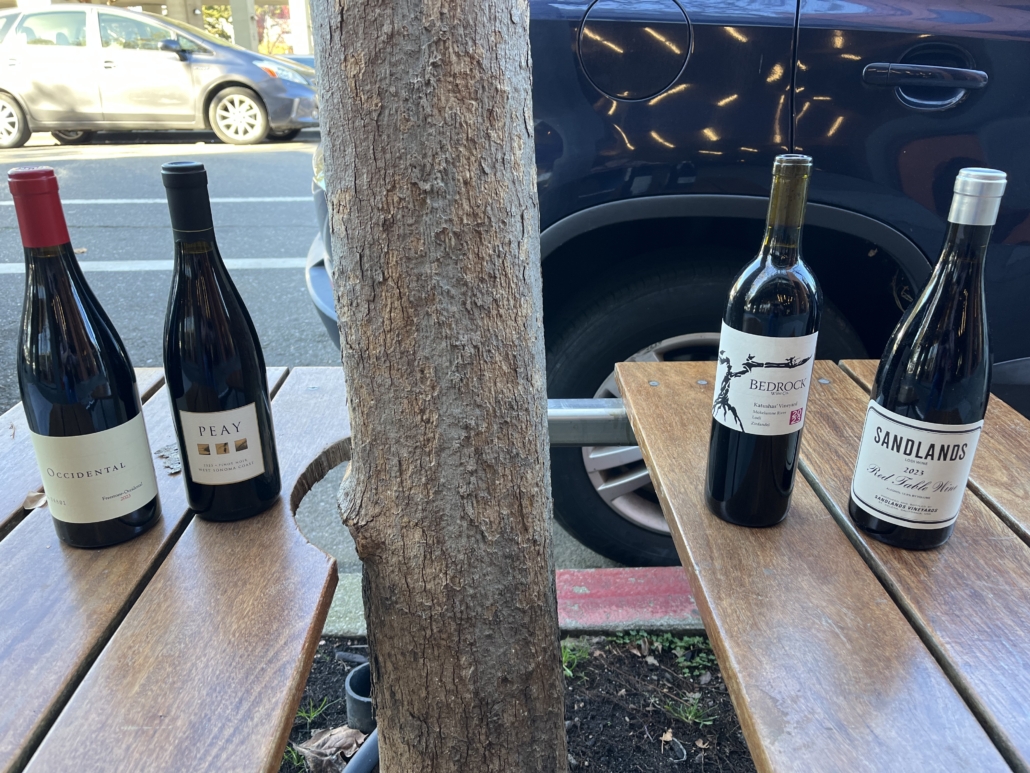
Often, California wine regions are drawn over-broad and without homogeneity of values or style, resulting in useless generalizations about the wines. But occasionally, we get it right, and carving the West Sonoma Coast out of the too large Sonoma Coast AVA has made the label meaningful. The area is so cool and the fog and breeze off the ocean so consistent that ripening pinot above 13 percent potential alcohol is a challenge, not a given.
And it just so happens that turkey and cranberry pair very well with the less-oaked, red-spectrum fruits you consistently get from these wines. We have some of the best examples from the West Sonoma Coast region—Peay and Occidental come to mind, but we have many other options.
Some would say there’s no more American wine than zinfandel; it has proved capable of thriving in California longer than any other grape. Another victory in meaningful wine labels comes from the new Mokelumne River AVA, a sub-zone of Lodi. If you remember Lodi as shorthand for very ripe and alcoholic wines, you’ll be quite surprised by what’s currently going on.
I thought Arnot-Robert’s exciting Kirschenmann Vineyard zin was an outlier, more a product of that winery’s style than an exemplar of place. But now I’m not sure. Bedrock’s Katushas’ Vineyard is in the same area (and also well more than 100 years old) and is similarly delicious—dark-fruited and gently textured, yet with freshness and not heavy. The farmer most associated with preserving ancient vineyards in California, Tegan Passalacqua, has taken special interest in the area and is making wonderful wines under his Sandlands label. All would make great selections for your holiday feast.
— David Gibson
Chinon—Gem of the Loire
Once considered a worthy rival to Bordeaux, the Chinon appellation sits in the heart of the Loire Valley, where it is exposed to both cooling coastal breezes and inland warmth. Almost all of the wine produced in Chinon is cabernet franc, save for a tiny output of chenin blanc. Cab franc from Chinon is a study in balance—fresh and vibrant, but often with considerable depth, and boasting a range of flavors from fruity to savory to herbaceous to earthy.
the Baudry estate
At Paul Marcus Wines, one of our favorite Chinon producers is Bernard Baudry, who owns 32 hectares of vineyards in the AOC and offers a variety of distinct cuvées. ‘Les Grézeaux,’ the domaine’s oldest plot (more than 60 years), is located in the plains near the Vienne River, where the gravelly soils produce wines with a velvety texture and aromatic lift. It has enough meat on its bones to stand up to heartier fare, but the smooth tannins and modest 12.5 percent alcohol allow it to pair eloquently with a whole host of dishes. We also have Baudry’s stunning ‘La Croix Boissée,’ which comes from further up the slope, where Chinon’s renowned limestone-rich soil (called tuffeau) is prevalent. A wine of intensity, gracefulness, and complexity, it is a shining example of what Chinon can offer.
Domaine Philippe Alliet is another esteemed Chinon producer, and their wines tend to come off as a bit “cleaner” than that of other producers in Chinon—not as leafy and earthy, not as meaty, but pure and precise. In addition, we have the ‘Varesnes’ offering from Domaine Jourdan, which comes from a part of the plain where the soil is clay-heavy, giving the wine a notably spicy tinge. Fermented in steel and aged in concrete, it is a structured and mineral wine, but the omission of any oak helps the wine maintain elegance and equilibrium.
— Marc Greilsamer
Bottle Rocket: 2019 Roagna Langhe Rosso
Barbaresco, Piemonte, RoagnaThere’s a reason why nebbiolo is one of the world’s most treasured grapes. Few others can deliver its total package—gorgeous fruit, supportive tannins, bright acidity, elegant spice, and earthy charm. When done correctly, nebbiolo offers balance, complexity, intensity, and finesse of which most grapes can only dream. It’s also an incredibly versatile variety, producing wines in a wide range of styles, each accentuating different characteristics.
Three generations: Luca Roagna with father and son
At Paul Marcus Wines, we are no strangers to nebbiolo. From highly prized Barolo and Barbaresco to young and fresh table wines, our shelves boast a wide selection of nebbiolo in almost every incarnation. Occasionally, we get a version that stands apart from the others, and that certainly is the case with the 2019 Roagna Langhe Rosso.
In the capable hands of Luca Roagna, this estate puts out some of the world’s most prestigious Barolo and Barbaresco. But this more “modest” offering—50 bucks—is a stunner in its own right. The grapes come from younger vines in Barolo and Barbaresco, and the wine is crafted in pretty much the same way as its more esteemed siblings.
As soon as you pull the cork, a brilliant burst of perfumed raspberries pops out of the bottle. Though it leans toward a floral and graceful style—more roses than tar—it has a bedrock of refined, well-integrated tannins that underpins the lovely and delicate fruit and exotic spice notes rather than overwhelming them. It’s lively and expressive while maintaining its backbone and edge—a wonderful example of the outstanding, old-school 2019 vintage. Slow-braised beef, anyone?
Yes, you can probably lay it down for a few years and be amply rewarded, but in all honesty, it’s hard to imagine it being any more satisfying than it is today. We have a handful of bottles left, so there’s still time to find out for yourself.
Reflections: Exploring Loire Valley Wines
UncategorizedAt the start of June, Chad and I hosted a Loire Valley-inspired dinner with our friends at the Wolf. We were joined by many loyal shop customers along with a handful of industry veterans—all equally eager to embark on this journey. We had no idea there would be such immediate interest in the event, and the high demand meant that our meal was a slightly snug fit, which only emphasized the intimate, friendly atmosphere.
Already off to a great start, the most unusual and thought-provoking course was the “surf & turf” steak tartare served on top of octopus carpaccio with herbs, all wrapped together with a most luxurious olive oil. Shocking, but highly effective! This was paired with Paul Prieur’s Sancerre ‘Pieuchaud Silex,’ a focused, mineral, chalky sauvignon blanc, as well as his Sancerre Rouge, a lifted, delicate pinot noir boasting red fruit and dried earth that did not overpower the food.
As the evening continued, chef Yang Peng continued to impress. With the two cabernet francs—the 2015 Domaine de la Chevalerie Bourgueil ‘Bretêche’ and the 2021 Bernard Baudry Chinon ‘La Croix Boissée’—she served the most melt-in-your-mouth pork belly and a spiced beef brisket (garnished with shaved jalapeño and a kiss of basil). It takes such skill not only to pair the wines but to elevate them; both of these wines tasted better than they ever have!
One goal of the dinner was to disrupt the expected serving progression of lightest wines to richest. Not only did we have the Sancerre blanc and rouge served side by side, but we also toggled from cab franc to chenin blanc and then back to red, before moving on to dessert wine. We also snuck in a brief cheese “interlude” to refresh the palate and the mind—an ash-rubbed goat’s milk served with an aged Muscadet (the 2015 Huchet Muscadet Monnieres Saint-Fiacre). It was a brilliant choice.
One of my favorite wine duos was a “battle” of chenin vs. chenin: the 2019 Thibaud Boudignon Savennières ‘Clos de Frémine’ against the 2020 Domaine Belargus Anjou Noir. At first, these two wines were vastly different, the Belargus being the richer, nuttier, more generous wine (a product of the warmer vintage and élevage in slightly more new oak), and the Boudignon being stony, mineral, and filled with mouthwatering acid. But as they sat in the glass, the Boudignon gained richness, and the Belargus grew focused—both wines coming together toward the center.
After the plethora of wines on the menu, Chad surprised the group with two bonus selections from his cellar: Boudignon’s 2013 Savennières (a blended wine from the estate’s early days) and the 2013 Domaine du Collier Saumur Blanc ‘La Charpentrie.’ Again, the two wines couldn’t have been more contrasted at the outset—and from two winemakers that are very close friends!
The night ran somewhat longer than expected, as we were all reluctant to depart such a warm, welcoming place. We eventually pulled ourselves away and made our way home—sleepy, content, and dreaming of France…
— Ailis Peplau
Producer Profile: Tasting with Envínate
Envínate, Producers, SpainRoberto Santana in Tenerife, Canary Islands
A few weeks ago, a couple of my colleagues and I were fortunate enough to attend a seminar put on by our friends at Farm Wine Imports. Among the participants were two of the four individuals behind the wine label Envínate (loosely translated as “to wine yourself”). Roberto Santana and Alfonso Torrente guided us through the three distinct areas in which they work: Tenerife, the northern island of the Canary Islands; Ribeira Sacra, Galicia, in northwestern Spain; and Almansa and Albacete, in the Levante of southeastern Spain.
Since starting their winery in 2005, they have slowly been honing their style and growing their vineyard holdings. One of the things that stood out for me was the dynamic of four different individuals having the utmost confidence in each other to make growing and winemaking decisions regardless of region. They simply have more moving parts than most wine projects.
Alfonso Torrente in his native Ribeira Sacra
Another aspect of their impressive mission is their reinvestment of funds into the farming aspect of operations—as opposed to, say, building a fancy winery. Lifting up the growers they work with (and acquiring more vineyards for themselves) is truly an admirable endeavor.
I’ve been lucky enough to have worked with these wines for a little more than a decade, and they continue to impress in unexpected ways. The varied terroirs of Tenerife, for example, highlight the distinct differences of Listán blanco (aka palomino), Listán negro, and Listán prieto, to name just a few, when grown in volcanic soils. They also make elevated, aromatically charged Ribeira Sacras, based on mencía and others grapes grown on slate, quartz, gneiss, and even decomposed granite flecked with feldspar. The uniqueness of their wines from Albacete and Almansa (based on garnacha tintorera, moravia agria, and pardillo blanco) also stands out, with grapes grown in clay, chalk, sand, and limestone.
This is a producer worth seeking out if you are unfamiliar and at all curious. Please stop by the shop to learn more about this remarkable project.
Women in Wine Evolution
California, Hungary, Producers, Regions-Emilia Aiello
Women winemakers are not a new phenomena, but in the last few years as I deep dive into my own area of interest and expertise (southern Italy), I have noticed a curious commonality in emerging wine regions: women.
Italy is well established on the wine map, but certain regions remain obscure. You know where Rome is, but what about Lazio, the entire region that surrounds the ancient city? As of late, Lazio is gaining momentum. Perhaps the hype has yet to reach the United States, but in Italy the region is putting on numerous tastings each year to highlight the local producers and grapes— Lazio is hyping up Lazio. Initially, creating interest in the local area is more important than abroad as working the local community inevitably works the local economy. My eyes were already on Lazio when I worked as the wine director at a Roman osteria in New York City, but before I tasted the wines of Maria Ernesta Berucci I had yet to really experience great Lazio wine. Her vini had an entirely new character— wild and bright, with a depth of flavor I had noticed only a handful of times in my youthful career. The wines intrigued me so much that I decided to meet Maria Ernesta on her own turf (vineyards) in Piglio. I met a woman so immersed in her work that it had no separation from her life. Not as as workaholic, but rather someone who applies the same ethos and dedication to their work as they do to their overall way of living. I also discovered that Maria Ernesta is well integrated in her community, aligning herself with vignaioli (winegrower in Italian) who follow similar principles. She shows up at every community tasting event and is part of Ciociaria Naturale, a coalition of small producers from a very specific part of Lazio whose goal is not just to make good wine, but to foster community and pride in an otherwise energy-barren region.
Once in tune to Maria Ernesta, my palate was primed to taste wines differently. I began to look to other regions of Italy ramping up— who was behind this energy shift, and why now? In Abruzzo, for instance, women are emerging as some of the brightest talents (Tiberio, Ciavolich, and Emidio Pepe‘s granddaugher, Chiara is officially taking over the winemaking side). Their wines are amazing, but in a particular way. Similar to the story of Maria Ernesta in Lazio, their total immersion in their work and ability to incorporate their business skills with their agricultural and winemaking prowess are bringing hype to the region among consumers and the younger local generations. Women are often at the forefront of social movements and change, and it seems that the wine industry is no outlier.
I suppose it would now make sense for me to give you an exposé on the aforementioned names and wines, but my story is not finished. These women inspire me to step outside of my comfort zone, and I am following the breadcrumbs to other regions and winemakers that make wine with this particular energetic charge. Paul Marcus Wines gives me the space and privilege to taste and learn about pretty much every wine region of the world. Amazingly, that energy and wild nature that I first experienced tasting Maria Ernesta’s cesanese wine from Lazio, is a throughline in particular wines made in other countries, regardless of grape and terroir. My theory is perhaps now clear. Of course, I am not claiming that only women are capable of making charged vino, but rather it takes a certain investment—winemakers that have fully bought in to what they do and who view grape growing and winemaking as a way of life. I just happen to notice this approach is more prolific among women.
For Women’s History Month I chose two women trailblazers who are not Italian, that have opened up my mind and taste buds to new possibilities. They successfully weave in their own imaginations and experience to create wines that are somehow equally wholly unique and timeless classics.
Terah Bajjalieh of Terah Wine Co.
Terah Bajjalieh is a winemaker and consultant from California. A native Californian with Palestinian roots, Terah refined her unique style and found her love of wine by way of food and from her travels across the globe. She started her professional career in the hospitality industry studying at the International Culinary Institute in California. She then spent time working in wine bars, a Michelin-starred restaurant, wine education, and consulting in the Bay Area. The next step for Terah was to ambitiously immerse herself into the international world of wine, studying Enology and Viticulture in both Spain and France. She has completed 13 harvests in five countries: Meursault (France); Barossa Valley (Australia); Marlborough (New Zealand); Mendoza (Argentina); Sierra Foothills (U.S.); Sonoma (U.S.); Napa Valley (U.S.); The Willamette Valley (U.S.).
The California wine climate is shifting and while the days of big house cabs and zins are still here, they have moved aside to allow for more diversity in grape variety and winemaking. Terah’s philosophy comes from years of experience and experimentation. She focuses on lesser known California growing areas as well as Mediterranean grape varieties. Her wines are a pure and expressive blend of CA climate, Mediterranean vibes, and Terah’s kind and discerning personality.
2023 Falanghina Skin Contact Orange (Lost Slough Vineyard in Clarksburg)
100% Falanghina, native to the Sannio area of Campania, Italy
Situated in the heart of the Clarksburg AVA, this growing region benefits from the cool breezes that flow from the Sacramento River Delta. Combined with the rich sandy, clay loam soils, it is an environment that is optimal for producing exceptional wine grapes. The maritime influence tempers the region’s warm days, allowing for slow and even ripening, which preserves acid and results in wines with incredible freshness.
100% destemmed and fermented on skins through primary fermentation for 12 days. This process allows the grape skins to impart color, flavor, and texture, resulting in a wine with enhanced complexity and character. Pump-overs were performed during the maceration period, and fermentation naturally commenced due to the wild yeast and native bacteria. These techniques ensured even extraction of flavors, and tannins from the skins, promoting a harmonious integration of elements. The wine was aged on fine lees for 10 months in stainless steel. Unfined and unfiltered to preserve texture and integrity.
Crisp notes of freshly picked green apples and vibrant citrus peel intertwine with more intricate layers of brioche, dried apricots, and honeyed figs. Chewy tannins with long-lasting minerality. This is a very approachable orange wine, with zero funk. Think of it more like a rich white when you choose your food pairings: hard cheeses; hearty roast chicken dishes; al pastor tacos.
2024 Terah Wine Co. Vermentino (just bottled/new release!)
100% Vermentino
The vermentino grape’s origins are unknown, with Spain, France, AND Italy claiming native rights over the variety. Regardless of its true origin, it is 100% Mediterranean. 2024 was just bottled four weeks ago and is making its debut with Paul Marcus Wines. The classic subtle peachy stone fruit, fresh cut grass, lemony zing is reminiscent of a Corsican version, while the palate has an oily/silky feel more akin to Sardegna’s blueprint. I suppose what we are tasting is the richness of the California climate and fertile soils, combined with Terah’s unique ability to coax out the grape’s vivacious acid and minerality.
Sarolta Bárdos of Tokaj Nobilis
“Sarolta is one of these people who is constantly and seemingly unconsciously sampling herbs, smelling blossoms, inspecting leaves and so on. Her palate isn’t just shaped and informed by the grapes, but everything surrounding them”– Eric Danch
Hungary is not a country that first comes to mind when we list off the great wine regions of the world, though the sweet Tokaji wines made from Hungary’s native furmint grape is one of the most reputable sweet wines of the world. It remains as the country’s flagship wine and the only testable Hungarian wine on the blind tasting portion of certified sommelier exams*. So what about the region’s other varieties and wines? While they do not totally remain in oblivion, they are so obscure we really only source them from one importer here in California, Danch & Granger.
Tokaj, Hungary has an extraordinary number of women winemakers. According to Eric Danch, importer and our de facto Eastern European wine guru, the reasons for this are varied: since sweet wines were historically the most important wine, it’s often cited that women had a better sense of sweetness and therefore when to pick the grapes. Out of practicality, they found themselves in the cellar tasting as well. Another potential impetus could be that during the communist period, men were obligated to go out and work, leaving the women at home to tend to the family, cook, and make the house wine.
Born and raised in Tokaj, Sarolta Bárdos possesses a keen awareness of the changes and challenges facing the region. Beginning her career studying at the University of Horticulture in Budapest, she took advantage of the recently fallen Iron Curtain and spent time in France, Italy and Spain. Upon returning to Hungary, she worked at Gróf Degenfeld and soon after became the inaugural winemaker at Béres Winery in nearby Erdőbénye overseeing 45 ha of vineyards. Preferring closer attention to detail and the total knowledge inherent in small-scale winemaking, she left and planted her own 6 ha in 1999. In 2005 she converted a traditional 19th century house into a winery and cellar in the middle of the town of Bodrogkeresztúr. All sites are worked by hand, certified organic, and rely mainly on plant extracts, orange oil and sulfur. The wines embrace a myriad of volcanic soils with remarkable aromatics and balanced acidity.
2019 Tokaj Nobilis Barakonyi– fully dry
100% furmint
Underbrush. As if a warm breeze just rolled through kicking up a chalky/dusty whiff. Subtle oak spice with rich caramelized pineapple and lemon curd notes on the palate, offset by high, mouthwatering acid. I usually don’t like comparing unique wines and grapes to more recognizable, pricey regions. My concern is that I will take away from the obscure wines’ unicorn vibes, but to give you an idea of what kind of value this is for the quality: think southern Burgundy (chardonnay) but with riesling** acid. What impresses me more than simply the high quality of the wine is that Sarolta achieves it via minimal intervention techniques. This wine is made from more than organic grapes— she uses orange oil in the vineyards, for Bacchus’s sake! In the cellar, it is fermented with wild yeasts, has very minimal sulfur additions, with no fining, clarification, or filtration.
*for sommelier exams and blind tasting, there is a list of grape varieties made into certain styles of wines from various regions that the examiner is allowed to present to the examinee. This list does expand and change as our collective knowledge and curiosity grow beyond French appellations and “classic” grape varieties. But to give you an idea of how slow the process is of allowing more wines into the blind tasting exam, the only testable Italian red wines are Barolo made from the nebbiolo grape; and Brunello and Chianti Classico made from the sangiovese grape (Italy boasts over 400 documented native varieties). The sweet Hungarian Tokaji wine has been on that codified list since the inception of the certification exams and remains the only wine from Hungary allowed on the tasting portion of the exam.
**furmint and riesling share a parent grape, Gouais Blanc.
Reflections: In Search of … Less
News, Riesling, Stories From The Shop“Dry January” is behind us, but many of you might decide you need to “cool off” at other times throughout the year. Whether you are taking a break from drinking altogether or simply trying to slow it down, we have got you covered. At Paul Marcus Wines, we have a generous selection of non-alcoholic and low-abv wines available.
What is non-alcoholic wine anyway? Dealcoholized wine is produced when the alcohol has been forcibly removed from the juice, either by reverse osmosis or vacuum distillation. The resulting juice concentrate is tweaked so that the flavors best mimic the tastes and textures of wines with alcohol. By U.S. standards, a wine must contain less than 0.5 percent alcohol by volume (abv) to be classified as alcohol-free. Some of my favorite non-alcoholic options at the shop include the Leitz Riesling (both sparkling and still), Eric Bordelet’s Jus de Pomme (sparkling apple juice), and the customer-beloved Phony Negroni.
However, as heat waves continue to grip both Europe and California, we are seeing ever-riper grapes with almost every vintage. We now even see white wines reaching past 14.5 percent abv! Winemakers must learn how to regain balance and freshness for their wines, and this has led winemakers and growers to seek cooler zones and shady hillsides.
In other cases, many growers simply choose to harvest the grapes earlier—on average, at least a month earlier than what was once traditional. Of course, this technique isn’t without its complications. For one, picking early for lower potential alcohol might result in grapes that are lacking phenolic ripeness—meaning they might be devoid of the textures and flavors that make chardonnay taste like chardonnay. Alternatively, wines that have natural sweetness, such as some rieslings, Lambrusco, or Moscato, tend to be lower in alcohol because there is sugar from the grapes that has not been fermented, known as “residual sugar.” In these examples, bright acidity balances out the sweetness so that the wines are not cloying.
When making low-alcohol-wine recommendations, I often seek out options grown at high elevations or on the coast. Some of my favorite “mountain wines” are grown in cooler climate zones like those around Mont Blanc (Savoie, France) or the foothills of the Italian Alps (Alto Piemonte, Italy). Some coastal areas include Galicia (Spain), Liguria (Italy), and the Loire Valley (France).
A couple of my favorite low-abv wines in the store right now include: Avinyo 2023 Petillant (10.5 percent), which is refreshing and a little bubbly, and Jolie Laide 2023 Red (11.6 percent), which offers lightness and freshness while still pairing well with both warm winter vegetables and barbecued meats.
– Ailis Peplau
Bottle Rocket: Two from the Jura
Jura, PairingsNestled in eastern France between Burgundy and the Swiss border, the Jura region has amassed a bit of a cult following among wine connoisseurs. With its cool climate, hillside vineyards, unique winemaking styles, and indigenous grape varieties, Jura is producing distinctive, highly prized wines that benefit from their limestone-rich soils.
Because of relatively limited production and increasing popularity, many Jura wines can fetch steep prices. At Paul Marcus Wines, we are currently featuring a couple of Jura wines that offer a glimpse of the region’s magic without the hefty price tag.
The resulting blend offers appealing layers of complexity—it delivers ample fruit and texture balanced with an exotic savory edge. It works rather well with robust, creamy sauces (preferably with mushrooms), and it was a terrific choice with sautéed pork chops in a butter, garlic, and lemon sauce.
The 2022 Kevin Bouillet Trousseau comes from a sub-region of the Jura known as Arbois-Pupillin. One of the area’s famed indigenous grapes, trousseau can be difficult to deal with—it requires plenty of sunshine to ripen, yet its higher sugar content makes it susceptible to higher alcohol levels. These days, producers like rising-star Kevin Bouillet, a native of the region, know how to tame trousseau, and his buoyant version (his first vintage making single-variety trousseau) beams with bright red-berry fruit, notes of pepper and spice, vibrant acidity, and a hint of smoke.
This bottle was the perfect match for “reuben casserole”—a hearty melange of pastrami, sauerkraut, Russian dressing, toasty rye bread, and Gruyere cheese—thanks to its gentle earthiness and palate-cleansing freshness.
To learn more about these two standouts and other wines from the esteemed Jura appellation, please stop by the shop.
Celebrating Holidays: What’s on Our Wishlists?
Events, HolidaysBuying a bottle for a persnickety wine professional (or even a wide-eyed neophyte) can be a fraught mission. The options are almost limitless in terms of style, region, and price. Fear not: The staff of Paul Marcus Wines is here to help.
If you visit the shop, of course, we’ll be happy to walk you through the choices based on your budget and the personal tastes of the recipient. To get you started, however, we thought it might be useful to share what’s on our own personal wishlists. Spoiler alert: Despite our varied and distinctive palates, it seems we all lean toward the “classics” when eying that elusive bottle. Barolo? Champagne? Yes, please.
Brutal Discernment
Gifting a jaded wine pro a bottle makes sense on the surface–they like wine; ergo, it’s an appropriate gift. But below that surface is their possibly brutal discernment. How best to navigate this shoal?
Champagne is your best bet–it’s both delicious and useful. Recently, I had the Jacquesson 744, a Champagne given some extra time to rest on its lees and in the bottle, and it showed brilliantly against three top-notch rivals. The three years of extended aging has mellowed its youthful acidity just a bit and given it a greater fullness and natural weight that isn’t coming from apparent oak or winemaking artifice. All Jacquesson bottlings are meticulously made, but this one is in a particularly satisfying place. I’d be psyched to be gifted a bottle.
— David Gibson
Spanish Lullaby
I’m feeling inexplicably Spanish this holiday season, so if you’re looking for wines that you could put under my tree, what about an old Rioja? As is the case with aged tempranillo, be ready for anything–dusky notes of mushrooms, forest floor, certainly some folded fruit and saddle. Also look for cigar box and desiccated citrus, for rose petals and tar. Any of these wines with a bit of grilled beef and mushrooms should get the job done.
These wines can be extremely difficult to get, but we have a few noteworthy bottles in the shop, including a couple from the fantastic 1970 Rioja vintage–which, compared to virtually every other region in the world, represent a screaming bargain. We also have a split from 1951, which is, well, 1951!
Beyond that, I’m always excited for a chilled Champagne or Cava on Christmas morning. I can only think of two or three hundred that would fit the bill…
— Chad Arnold
Badass Bubbles
I love sparkling wines any day of the week–Champagne, in particular–and even more so during the festive holiday season. So, with that in mind, I would be thrilled to receive a gift of Marie Courtin Champagne ‘Presence’ cuvee (although any of her wines would be an exciting choice).
This wine checks all of the boxes for me, most notably excellent biodynamic farming and a crisp elegant flavor profile highlighted by that brut nature zing. Plus, the house is run by a badass woman who named the winery after her grandmother. I’m a sucker for Blanc de Blancs Champagne, and this wine has both the chalky texture and high-toned mineral acidity I crave, as well as the added subtle nuance of pinot blanc, which, to me, brings out delicate floral aromatics and flavors.
I’d also love to explore the three classic (and ageable) white wines made by the esteemed Quintodecimo in Campania. With grapes grown in the mountainous zone of Irpinia, these wines have certainly sparked my curiosity.
— Ailis Peplau
Brightness and Brilliance
Drinking the 2022 Cavallotto Langhe Nebbiolo is like drinking a wonderful Barolo. Made from younger vines in the Bricco Boschis vineyard in Castiglione, the wine exudes brightness, brilliance, and balance. With a rich, complex core of fruit, it definitely punches above its weight.
— Paul Marcus
Lively and Lovely
No one in the history of the world has ever said (or thought), “Oh no, they brought Champagne.” I am always happy as can be to receive bubbles, and it doesn’t have to be the fanciest, most expensive bottle to provide immense pleasure and satisfaction. The Hure Freres ‘Invitation’ is an excellent case in point. What a beautifully balanced, traditional expression of Champagne this is–40 percent each pinot noir and pinot meunier, with 20 percent chardonnay. It delivers tart apple and citrus notes, excellent minerality, and a nice touch of brioche–dry, refreshing, lovely.
— Joel Mullennix
Perfectly Poised
I was lucky enough to drink the 2018 Cappellano Barolo ‘Otin Fiorin Piè Rupestris’ over a long lunch at the superb restaurant Repubblica di Perno in Monforte d’Alba earlier this year. Even in its comparative youth, this is a perfectly poised wine, with everything in its place. Tar and roses; power and elegance; newness and nostalgia. I would happily drink it again during a special holiday meal this year–or a decade from now. (Available for in-store purchase only.)
— Mark Middlebrook
Kaleidoscopic
Maria Teresa Mascarello is crafting some of the most compelling nebbiolo on the planet. The red-fruited Bartolo Mascarello Barolo offers kaleidoscopic aromatics of earth and spice, coupled with a silky tannic texture that just blows the mind.
I’ve had this wine several times before, in different vintages and with varying amounts of bottle age. We currently have both the 2019 and 2020 Mascarello, and while I haven’t tasted either vintage, my past experience has only heightened my anticipation. These wines have shown me what very few other red wines ever have, and I’d love to recreate that sensation.
— Jason Seely
Geek Out
Giuseppe Russo (right) in the vineyard with his winemaking partner, Emiliano Falsini
Since I’m a wine professional, and someone who is infinitely curious about wine, it could be a daunting task for someone looking to gift me a bottle. But it certainly doesn’t have to be. How well do you know your gift recipient, their interests, and maybe even their recent travels?
My friends know I often travel to Italy and frequently teach wine classes on the Mt. Etna growing region in Sicily. I personally would be overjoyed if someone snagged me a higher-end bottle from Mt. Etna, like the 2020 Girolamo Russo Feudo di Mezzo. A little research reveals that 2020 is a wonderfully balanced year, built for cellar aging, but also very giving in its youth if I couldn’t wait to open it.
Giuseppe Russo is a star on Mt. Etna, producing terroir-driven wines with his unique style of fermenting in used barrique. I would be so impressed that my friend took the time to listen to my interests and find me a wine I would truly geek out on.
— Emilia Aiello
Throwback
The Oddero family has been making wine in Barolo for more than 150 years, and by 1900, they were already exporting their wines to the States in small oak barrels. Today, Oddero remains one of the most respected houses in the region. They’ve been tending the slender Rocche di Castiglione hilltop vineyard for roughly 80 years, and the wines from this steep and shallow cliff-side plot accentuate the more graceful, mineral tones of nebbiolo.
That’s why the 2019 Oddero Barolo Rocche di Castiglione ranks high on my list. I was fortunate enough to sample a previous vintage of this bottling (2008, I believe), and found it to be incredibly expressive and complex, elegant but not without ample stuffing. I’m excited to see what this illustrious producer and its superb vineyard came up with in the highly acclaimed “throwback” vintage of 2019.
— Marc Greilsamer
Bottle Rocket: 2020 Le Petit Saint Vincent Saumur-Champigny – Les Poyeux
Le Petit Saint Vincent, Loire ValleyDominique Joseph, of Domaine Le Petit Saint Vincent, works with less than a hectare of organically farmed old vines in Les Poyeux. (His family has owned these small parcels for decades.) The grapes are de-stemmed and fermented in concrete vats before resting in larger neutral barrels for about a year.
Dominique’s 2020 Les Poyeux is a wonderful example of the site’s capabilities. There’s a wave of dusky red fruit on the attack, and it’s buttressed by a distinct herbaceous streak and a notable hint of stony minerality. The ample acidity and abundant tannins (naturally softened by the sandy terroir) tell you that this wine will age gracefully for several years, although it’s already a knockout–and at $50, it’s quite a fair deal for a wine that comes from one of the Loire Valley’s most prestigious vineyards.
Dominique Joseph
Thanks largely to world-class bottlings by cult-favorite producer Clos Rougeard (and various disciples), Les Poyeux has been elevated to legendary status among cab franc lovers. This version from Le Petit Saint Vincent offers a chance to appreciate its charms without the hefty price tag that is often attached to these wines.
As the saying goes, “Les Poyeux c’est soyeux”–silky. Come visit the shop, and find out for yourself.