Sometimes, there’s just no convincing the people. Though sherry is a relatively recent discovery for me, I’ve been singing its praises for more than a decade–with little success. I hear all the familiar refrains: “My grandmother used to love her $6 sherry,” or “Who are you, Frasier Crane?” That’s fine–more for me.
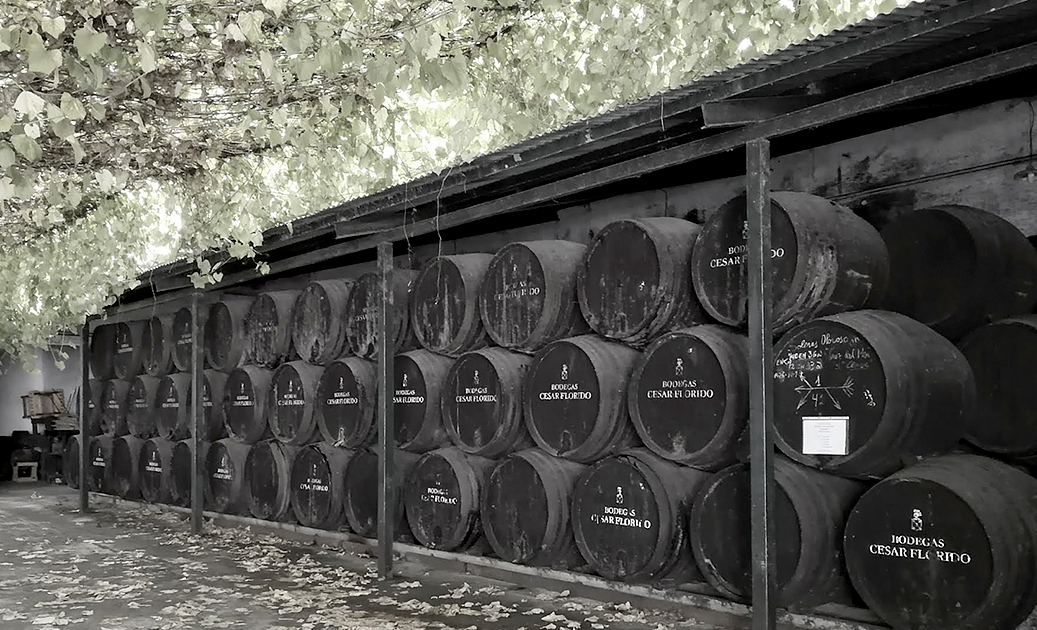
A solera at Bodegas César Florido
Made primarily from the palomino grape, grown on a chalky, limestone-laden type of soil known as “albariza,” sherry is an incredibly versatile and nuanced type of wine. Its homeland is Jerez (hence the name sherry), located on the Atlantic coast in Spain’s southwestern Andalusia region. Sherry can be mellow and easygoing, sharp and bracing, and everything in between. Some are as friendly and relaxed as an old dog; some have enough power and intensity to send ol’ grandma into cardiac arrest.
Sherry is produced using what’s known as a solera system, in which barrels are stacked in tiers to allow for fractional, cross-vintage blending. When the older stuff at the bottom is removed for bottling (a process called the “saca”), it is replaced at the top by the latest vintage.
The lightest, driest, and tangiest sherries are fino and manzanilla, which spend their aging regimen under a layer of yeast known as “flor” (a process known as biological aging). Amontillado and palo cortado begin life as a fino or manzanilla, but are allowed to oxidize after the yeast dies or is killed off by fortification–a combination of biological and oxidative aging– imparting a nuttier, more caramel-like tone while still retaining tang and freshness. Oloroso sherries are fully oxidative (no yeast) and are rich with toffee and dried fruit flavors, yet still mostly dry. Finally, there are sweet sherries made with grapes such as Pedro Ximénez (PX) and moscatel.
The three poles of the Sherry Triangle are Sanlúcar de Barrameda to the north (home to manzanilla), Jerez de la Frontera to the east, and El Puerto de Santa Maria to the south. At Paul Marcus Wines, we are proud to feature sherry producers from throughout the region (and even a couple that are technically outside the triangle).
Up in Sanlúcar, the venerable Bodegas Hidalgo-La Gitana has been making sherry since the 18th century. Their budget-friendly, young Amontillado Napoleon is bright and dry, with subtle hazelnut notes and a long, clean finish. For a special occasion, try the Amontillado Napoleon VORS, which is pungent, mouth-filling, and caramelized, yet still surprisingly focused and floral for a wine aged well more than 30 years. We also have the Wellington Palo Cortado VOS, a sophisticated 20-year sherry that, despite its age, never lets you forget it started out as a manzanilla–it’s sharp, salty, creamy, and nutty all at once, and a reasonably priced entry point into the world of high-end sherry.
Bodegas Faustino González was founded 50 years ago, but its Cruz Vieja line is a newcomer on the sherry scene. The winery is located in the San Miguel neighborhood of Jerez de la Frontera, where the higher elevation invites the Atlantic breezes in from the west. They source their grapes from the historic Pago de Montealegre vineyard, and they own soleras that date back nearly 250 years.
All of the Cruz Vieja sherries are bottled “en rama” (unfiltered), including a delightfully complex, persistent, and mineral Fino En Rama, aged under flor for six years, and a lightly toasted, elegant, amber-hued Amontillado En Rama, which spends six years under flor plus another six aging oxidatively. Their Palo Cortado En Rama spends only the first of its 12 aging years under the veil, but still exemplifies their lighter touch and commitment to freshness. For a completely different experience, their Pedro Ximénez En Rama is raisiny and sweet as molasses, yet is also highlighted by a few spicy, savory notes. Pour this one over a bowl of vanilla ice cream.
Around since 1896, Bodegas Lustau remains one of the best-known and most-respected sherry producers in the world, offering a wide selection of bottlings. At PMW, we offer two from their Almacenista collection–sherries that come from small, independent producers. The Fino del Puerto González Obregón is a salty, citrusy, and edgy five-year fino from a bodega in El Puerto de Santa Maria, while the Oloroso Emperatriz Eugenia, from a solera in Jerez de la Frontera started by Emilio Lustau in 1921, is rich, woody, dark, and robust, ripe with dried fruit yet still mostly dry.
From El Maestro Sierra, which dates back to 1830, we offer a 15-year Oloroso, which balances its richness with a few higher-toned elements. We also have a few bottles left of some of El Maestro Sierra’s most prized releases: the 70-plus-year-old Palo Cortado and the Oloroso 1/14–wines of tremendous electricity and complexity. In addition, there are a couple of VORS (Very Old Rare Sherry, more or less) bottlings from Osborne, the Oloroso Sibarita and the Pedro Ximénez Venerable. Like the two high-end offerings from El Maestro Sierra, these offer unique, once-in-a-decade drinking experiences that will make you wonder how grape juice can be made to taste that way.
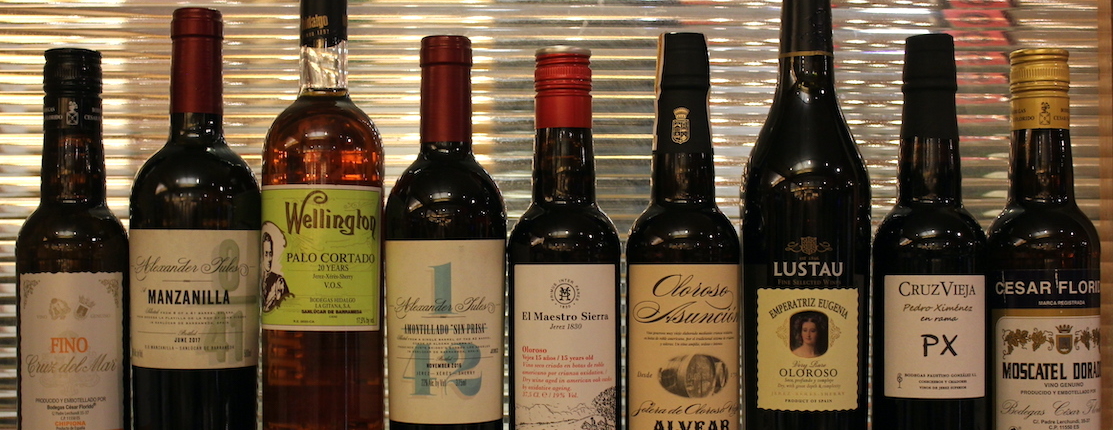
From outside the official Sherry Triangle, we have wines from Chipiona’s César Florido. Chipiona, located five miles west of Sanlúcar, is known for moscatel, a grape that produces sweet wines (though not to the level of PX) balanced with some acidity and gentle fruit and spice elements. Florido’s Moscatel Dorado is a great introduction, with its notes of orange peel and honey. Florido’s Fino Cruz del Mar is a three-year en rama fino that is quite dry, yeasty, and smoky–bright, but laid-back.
Bodegas Alvear can be found in Montilla, about two-and-a-half hours to the east of the Sherry Triangle. PX is king in Montilla-Moriles, and Alvear’s Oloroso Asunción is made with sugar-filled PX instead of palomino. Fermented into a welcoming off-dry style (19 percent alcohol, without any fortification), it combines sumptuous dried figs with a surprisingly lucid and lively finish.
Finally, PMW still has a few options from the Alexander Jules line. Alex Russan had been releasing his barrel-selected sherry since 2012, but recently moved on to other endeavors. Luckily, there are still a few bottles of his Amontillado Sin Prisa 1/42–all culled from a single barrel of a long-forgotten 42-barrel solera in Sanlúcar. Only 400 half-bottles were produced of this vigorous, dynamic, yet unexpectedly polished nectar.
With such an array of producers and styles, there’s a sherry that’s perfect for pretty much every part of the meal. As the old saying goes, “fino or manzanilla if it swims, amontillado if it flies, and oloroso if it runs.” Of course, it can be awfully rewarding as an aperitif or, especially, a digestif–a wine of reflection, if you will. Once you discover the wonders of sherry, trust me, you’ll be hooked.
Just don’t tell anyone else…
Why We Love: Wines from Etna
SicilyEtna is a special wine region. Actually, it is a magical region in many ways and has so much to offer beyond wine. Much of my interest and affection for Etna is due to Ciro and Stef Biondi, who were gracious enough to take me in for the 2018 harvest. In fact, the Biondi family (alongside Marc de Grazia, the Benanti family, and the late Andrea Franchetti) deserves much credit for Etna’s winemaking revival.
Mount Etna, the largest volcano in Europe, is located on the island of Sicily in the province of Catania, and Etna wines are grown on the slopes of the volcano. Locals often refer to Mount Etna as Mongibello (“beautiful mountain” in Sicilian dialect) or, simply, Mamma Etna. Mongibello also happens to be the scientific term referring to the most current layer of ash and lava caused by Etna’s eruptions dating from 15,000 years ago to the present day.
The History
Etna has been a central hub for quality wine production and research for longer than we realize. By the 13th century, Etna had established wineries or “commanderies” that were tended to by the Knights Hospitaller. These men were barons of the Catholic Crusades, and established themselves in the area for centuries.
The winemaking tradition persisted, and in the 18th century, the powerful and well-traveled Spitaleri family brought back French winemaking techniques. For generations, the family practiced these newer methods, elevating the otherwise high-yielding Etna vines to a status that rivaled Champagne and Bordeaux. This assertion is not an exaggeration; in the 1800s, this Etna family would bring back first-place prizes for their sparkling wines, outdoing their French counterparts at world expositions and trade fairs.
Etna’s reputation as a quality wine-producing area, with old-vine production on volcanic soils, blew up in the early 2000s. (Appropriate imagery, right?) It happened fast, and all at once. Producers have hustled to keep up with the production and quality standards that the export market continues to ferociously demand.
Despite its recent success, Etna is still an experimental hub. True to the region’s history, present-day winemakers experiment with different vinification and maturation methods–often with “minimal intervention,” a term that has become synonymous with the natural wine movement.
The Land
The region’s soils are … volcanic. Seems obvious, but what is not so obvious is that a volcano releases a different mineral, rock, and gas composition every time it erupts. Mamma Etna is still active and erupts often, naturally fertilizing the entire Etna area. Etna is also classified as a stratovolcano, which means it is a conical volcano, built up by many layers or “strata” that scientists date and name. After more than 100,000 years of eruptions from different volcanic systems, one can only imagine just how complex the Etna geology is. Despite its natural mystery, there are some specific clues when we taste Etna wines that lead us to certain zones of the volcano.
The three major classifications of Etna’s volcanic history are the Ellittico, Mongibello, and the Milo systems. Ellittico is the oldest of the three, encompassing eruptions from more than 15,000 years ago. Being older, these Ellittico soils are typically under the younger Mongibello strata. There are, however, some areas where the Ellittico soil is exposed: Randazzo in the north and Biancavilla in the south. Wines from vines grown on Ellittico in the north tend to be higher-toned, or “nervy,” meaning that the acid is higher, the fruit brighter, and the minerality more pronounced. Wines from Ellittico in the south have a similar mineral depth and energy, but are more concentrated in fruit–the sun favors the south side, and the vines pump out extra-ripe grapes.
The Etna DOC was established in 1968. It’s surprising it has not yet reached DOCG (Denominazione di Origine Controllata e Garantita) status because of its ever-growing reputation and demand for the wine. It could happen–the Etna Consorzio in the last few years has already taken strides to regulate production, and there has been some buzz of “upgrading” the denomination. For now, it remains a Denominazione di Origine Controllata. The production zone also has altitude delimitations (400-1000 meters above sea level), and a winemaker producing an Etna Rosso can only use grapes that are grown within this altitude range.
The Grapes
Etna has always been home to an assortment of grape varietals (some of which certain winemakers are committed to cultivating despite the fact that they cannot make the wine under the Etna DOC label). Etna, like the rest of Sicily and the Mediterranean, has a multi-cultural heritage, so it is not uncommon to find, say, grenache (brought over by the Aragons) still growing on its slopes.
Today, the mainstay red grape of Etna is nerello mascalese, even though this grape doesn’t show up in historical documents until the 18th century (where it is referred to as “negrello”). The late mention is probably due to the fact that the peasant population cultivated this varietal and had virtually no access to the historical record. Nerello produces stylish, complex wines with brilliant fruit, notable freshness, and a mineral edge. Carricante, the leading white grape, makes dry, structured wines with flinty, herbal notes.
At Paul Marcus Wines, we’ve been Etna aficionados from the beginning, and we continue to enjoy long, thriving relationships with a number of the region’s top producers. Benanti, with vineyards to the north, south, and east of the volcano, creates wines of tremendous finesse and refinement. Graci, in contrast, tends to offer wines of great concentration and depth. Then there’s Girolamo Russo, a producer who offers the best of both worlds. Finally, we have Marc de Grazia’s Terre Nere, one of the pioneers of the Etna renaissance.
Thanks to the versatility of the grapes, the diversity of winemaking styles, and distinctive terroir, Etna wines are quite well-suited to a wide range of foods and personal palates. To learn more about these Burgundian-style, elegant, and age-worthy wines, visit us at the shop.
— Emilia Aiello
Regional Roundup: Jerez (Sherry)
Jerez, SpainSometimes, there’s just no convincing the people. Though sherry is a relatively recent discovery for me, I’ve been singing its praises for more than a decade–with little success. I hear all the familiar refrains: “My grandmother used to love her $6 sherry,” or “Who are you, Frasier Crane?” That’s fine–more for me.
A solera at Bodegas César Florido
Made primarily from the palomino grape, grown on a chalky, limestone-laden type of soil known as “albariza,” sherry is an incredibly versatile and nuanced type of wine. Its homeland is Jerez (hence the name sherry), located on the Atlantic coast in Spain’s southwestern Andalusia region. Sherry can be mellow and easygoing, sharp and bracing, and everything in between. Some are as friendly and relaxed as an old dog; some have enough power and intensity to send ol’ grandma into cardiac arrest.
Sherry is produced using what’s known as a solera system, in which barrels are stacked in tiers to allow for fractional, cross-vintage blending. When the older stuff at the bottom is removed for bottling (a process called the “saca”), it is replaced at the top by the latest vintage.
The lightest, driest, and tangiest sherries are fino and manzanilla, which spend their aging regimen under a layer of yeast known as “flor” (a process known as biological aging). Amontillado and palo cortado begin life as a fino or manzanilla, but are allowed to oxidize after the yeast dies or is killed off by fortification–a combination of biological and oxidative aging– imparting a nuttier, more caramel-like tone while still retaining tang and freshness. Oloroso sherries are fully oxidative (no yeast) and are rich with toffee and dried fruit flavors, yet still mostly dry. Finally, there are sweet sherries made with grapes such as Pedro Ximénez (PX) and moscatel.
The three poles of the Sherry Triangle are Sanlúcar de Barrameda to the north (home to manzanilla), Jerez de la Frontera to the east, and El Puerto de Santa Maria to the south. At Paul Marcus Wines, we are proud to feature sherry producers from throughout the region (and even a couple that are technically outside the triangle).
Up in Sanlúcar, the venerable Bodegas Hidalgo-La Gitana has been making sherry since the 18th century. Their budget-friendly, young Amontillado Napoleon is bright and dry, with subtle hazelnut notes and a long, clean finish. For a special occasion, try the Amontillado Napoleon VORS, which is pungent, mouth-filling, and caramelized, yet still surprisingly focused and floral for a wine aged well more than 30 years. We also have the Wellington Palo Cortado VOS, a sophisticated 20-year sherry that, despite its age, never lets you forget it started out as a manzanilla–it’s sharp, salty, creamy, and nutty all at once, and a reasonably priced entry point into the world of high-end sherry.
Bodegas Faustino González was founded 50 years ago, but its Cruz Vieja line is a newcomer on the sherry scene. The winery is located in the San Miguel neighborhood of Jerez de la Frontera, where the higher elevation invites the Atlantic breezes in from the west. They source their grapes from the historic Pago de Montealegre vineyard, and they own soleras that date back nearly 250 years.
All of the Cruz Vieja sherries are bottled “en rama” (unfiltered), including a delightfully complex, persistent, and mineral Fino En Rama, aged under flor for six years, and a lightly toasted, elegant, amber-hued Amontillado En Rama, which spends six years under flor plus another six aging oxidatively. Their Palo Cortado En Rama spends only the first of its 12 aging years under the veil, but still exemplifies their lighter touch and commitment to freshness. For a completely different experience, their Pedro Ximénez En Rama is raisiny and sweet as molasses, yet is also highlighted by a few spicy, savory notes. Pour this one over a bowl of vanilla ice cream.
Around since 1896, Bodegas Lustau remains one of the best-known and most-respected sherry producers in the world, offering a wide selection of bottlings. At PMW, we offer two from their Almacenista collection–sherries that come from small, independent producers. The Fino del Puerto González Obregón is a salty, citrusy, and edgy five-year fino from a bodega in El Puerto de Santa Maria, while the Oloroso Emperatriz Eugenia, from a solera in Jerez de la Frontera started by Emilio Lustau in 1921, is rich, woody, dark, and robust, ripe with dried fruit yet still mostly dry.
From El Maestro Sierra, which dates back to 1830, we offer a 15-year Oloroso, which balances its richness with a few higher-toned elements. We also have a few bottles left of some of El Maestro Sierra’s most prized releases: the 70-plus-year-old Palo Cortado and the Oloroso 1/14–wines of tremendous electricity and complexity. In addition, there are a couple of VORS (Very Old Rare Sherry, more or less) bottlings from Osborne, the Oloroso Sibarita and the Pedro Ximénez Venerable. Like the two high-end offerings from El Maestro Sierra, these offer unique, once-in-a-decade drinking experiences that will make you wonder how grape juice can be made to taste that way.
From outside the official Sherry Triangle, we have wines from Chipiona’s César Florido. Chipiona, located five miles west of Sanlúcar, is known for moscatel, a grape that produces sweet wines (though not to the level of PX) balanced with some acidity and gentle fruit and spice elements. Florido’s Moscatel Dorado is a great introduction, with its notes of orange peel and honey. Florido’s Fino Cruz del Mar is a three-year en rama fino that is quite dry, yeasty, and smoky–bright, but laid-back.
Bodegas Alvear can be found in Montilla, about two-and-a-half hours to the east of the Sherry Triangle. PX is king in Montilla-Moriles, and Alvear’s Oloroso Asunción is made with sugar-filled PX instead of palomino. Fermented into a welcoming off-dry style (19 percent alcohol, without any fortification), it combines sumptuous dried figs with a surprisingly lucid and lively finish.
Finally, PMW still has a few options from the Alexander Jules line. Alex Russan had been releasing his barrel-selected sherry since 2012, but recently moved on to other endeavors. Luckily, there are still a few bottles of his Amontillado Sin Prisa 1/42–all culled from a single barrel of a long-forgotten 42-barrel solera in Sanlúcar. Only 400 half-bottles were produced of this vigorous, dynamic, yet unexpectedly polished nectar.
With such an array of producers and styles, there’s a sherry that’s perfect for pretty much every part of the meal. As the old saying goes, “fino or manzanilla if it swims, amontillado if it flies, and oloroso if it runs.” Of course, it can be awfully rewarding as an aperitif or, especially, a digestif–a wine of reflection, if you will. Once you discover the wonders of sherry, trust me, you’ll be hooked.
Just don’t tell anyone else…
Special Offer: Red Burgundy Blowout and Big Bottle Bonanza
Events, Holidays, News, SalePerhaps you’re looking for a singular bottle to dazzle your holiday guests. On the other hand, maybe you want a wine to savor by yourself in quiet reflection, in celebration of the holidays being over. In either case, for the rest of the year Paul Marcus Wines is offering a 15 percent discount on all red Burgundy wines priced at $100 or more. We offer a wide selection of standout wines from some of the world’s most prestigious pinot producers. Amaze your friends and family, or simply treat yourself after a long year.
In addition, we’ve extended our sale on all large-format bottles through the end of December! Get 15 percent off any magnum-sized (or even larger-format) bottle; receive 20 percent off if you buy two or more. Perfect for a last-minute gift. And remember: 1500 is the new 750.
Speaking of last-minute gift ideas, might you consider a membership in the PMW Wine Club? The PMW Wine Club offers three different courses, each at the same price of $75 per month, plus tax (and shipping, if required). Delight the wine lover in your life!
Celebrating Holidays: Wines for the Thanksgiving Table
Events, Holidays, PairingsSure, the holidays are about family and friends and togetherness–something most of us have been lacking lo these many months. But, nearly as significant, the holidays are about food and wine–and about sharing that food and wine with the ones you love (and have missed). So as we come together (carefully still) this season, let’s make sure you fill your Thanksgiving table with wines that will surprise, satisfy, and delight. To that end, the staff at Paul Marcus Wines has offered a prime selection to help get you started.
Go BiG
I haven’t seen my family in a large or large-ish gathering since 2019. The pandemic has accelerated and changed so much, but when I think of all the things I miss, and want changed back (though nothing will go back to what it was, exactly), family gatherings are at the top of the list. For this year’s Thanksgiving, I’m going to pop some Champagne and open both red and white Burgundy with our Thanksgiving meal. I’m thinking: go BiG. I haven’t gone BiG during the pandemic, but I’m feeling like life ought to be celebrated in a BiG way.
So here are a few selections for this year’s festivities:
Try a bottle of the astonishing 2012 Francis Boulard ‘Petraea’ Brut Nature, made from 100 percent biodynamically farmed pinot noir. The fruit for ‘Petraea’ comes from 60-80-year-old vines planted on sandy limestone soils in a single estate parcel in the northeast corner of the Montagne de Reims. The combination of ripe fruit and a long aging process, with no dosage, yields a dynamic, captivating result.
Or perhaps try a Burgundy or two from the masterful Dominique Lafon. His red wines are deep and complex–I have loved them for 30 years, and his new releases might be his best yet. For instance, the 2017 Dominique Lafon Beaune Epenottes, from a plot farmed by Dominique just outside of Pommard.
His whites are gloriously bright and exuberant as well. Grab the 2019 Dominique Lafon Meursault if you want a total stunner of a rich wine with ripping acidity. Sensuous. For more ideas, come on in and ask us for recommendations. We’re always happy to help.
— Chad Arnold
Have You Heard About Poulsard?
Poulsard (also known as ploussard) is the second-most-planted grape (after chardonnay) in the Jura. Thin skins and a pale red color are the signatures of this variety, and long ferments draw out maximum flavor and texture. The 2018 Domaine Ligier Arbois Poulsard spends 10-12 months in vats before bottling, increasing its generous flavors, textures, and scents of sour cherry, pomegranate, cranberry, and earthy spices. Bright and complex with good acidity and a lovely finish, it’s a perfect choice for your holiday gatherings.
— Rene Duer
It Ain’t Easy Being Easy
On T Day, we celebrate being as stuffed as a turkey. Therefore, the wines should be easygoing–easy on the brain, easy on the stomach. The 2018 Unturned Stone Stowaway Red fits the bill. Zinfandel and carignan are richly flavored grapes that tend towards weight and alcohol, but this winemaking couple handles them beautifully. The blend is only 12.5 percent alcohol, has no silly additives, and comes from the historic, organically farmed Talmage Ranch vineyard. It drinks soft and fresh with berrylike fruit, without being at all “sweet.” It’s just easy to like.
–David Gibson
Beaujolais Bounty
The versatile, nimble wines of Beaujolais, made from the gamay grape, are ideal accompaniments to the wide-ranging Thanksgiving feast, and we have a number available at PMW.
The 2019 Jean-Claude Lapalu Eau Forte comes from one of the most revered growers and winemakers in the region, a leader in the natural wine movement. While not bottled as a single cru, the grapes for this wine are sourced from Brouilly. Lapalu does not make Eau Forte in warmer, riper vintages, as he intends it to be lighter on its feet with less tannic structure. It is aged in amphora, which adds to its silky texture, and it has the flavor complexity of a cru wine without the extraction and tannin. A great start to the heavy meal, it will complement the pre-meal cheese spread and cranberry preserves.
The Moulin-à-vent cru takes its name from the iconic windmill (moulin) that proudly stands above the vineyards. Nicknamed the “Lord of Beaujolais” because of its wines’ “noble” fragrance, this appellation tends to offer wines with a bit more body and intensity. The 2017 Merlin Moulin-à-vent is just starting to show its tertiary notes from the bottle age–dried cranberry, dried rose petal, and forest floor. Aged in new French oak, with notes of licorice and spice as well as a solid tannic structure, it’s a wine to last the meal from start to finish.
Julienas may not be as notable as, say, Morgon, but that is not because it is lacking in potential. The region experiences more sunlight exposure than the other Beaujolais crus, and when combined with its varied, decomposing blue stone and schist soils, Julienas can pump out wines of real power. Expect a weightier mouthfeel with darker fruits. The lively 2019 Laurent Perrachon Julienas is a classic example at a pretty unbeatable price. It boasts dark, peppery fruits with some tannin, though not quite as dry as the Merlin. It will be great with the all-in-one forkful of dark turkey leg meat + stuffing + cranberry sauce.
–Emilia Aiello
Wild Turkey
Win the “most far-flung and obscure island wine” sweepstakes this Thanksgiving with the 2020 Tsiakkas Mouklos Mavro, a light, shockingly fresh red from the nation-island of Cyprus. The Tsiakkas family farms 80-year-old, ungrafted, bush-trained vines in sandy, volcanic soil at over 3,000 feet of altitude. Mavro Ambelissimo is the variety, and Mouklos is the name of the vineyard. It’s super-light in color, and the profile is light red fruits, with delicate floral and herbal notes. As with gamay, poulsard, schiava, pelaverga, and similar wines, the great acidity and liveliness help this wine play well with everything on the Thanksgiving table. Definitely chill it a bit. Fun fact: The Republic of Cyprus issued a stamp featuring the wild turkey (Meleagris gallopavo) in 2009; someone there must be doing the Thanksgiving thing!
Philip the Bold, Duke of Burgundy, famously banned gamay from Burgundy in 1395. The 2017 Marchand-Tawse Coteaux Bourguignons Gamay proves him wrong. Here is gamay from 45- and 75-year-old vines in Vosne-Romanée–aromatically Beaujolais, but structurally Burgundy. Dark-fruited, stony, and earthy, with a hint of spice, it’s a stylish yet relaxed guest on the Thanksgiving table. It’s the absolute antithesis of Beaujolais Nouveau and the perfect Venn diagram for lovers of real Beaujolais and/or Burgundy; a gamay of breed and class, yet not without that good gamay slash of hedonism.
–Mark Middlebrook
Oscar, Oscar, Oscar
Every family has that one cousin who’s just so affable, charismatic, and laid-back–the one who gets along with everybody and yet doesn’t talk too much. That, my friends, is Cousin Oscar. Made from a single parcel of old-vine cinsault in France’s Languedoc, the 2020 Domaine Rimbert VdF ‘Cousin Oscar’ is a luscious and bright bowl of red berries with just a whiff of peppery spice. Bursting with acidity and charm, this unassuming bottle will complement just about anything you throw at it–and at less than 20 bucks a pop, it’s perfect for those guests who might overstay their welcome. To quote Col. Sherman T. Potter of M*A*S*H fame, “Not enough o’s in smooth to describe this.”
–Marc Greilsamer
For more Thanksgiving suggestions, from the classic to the unconventional, please stop by or give us a call at the shop. Happy holidays!
Regional Roundup: Greece (and Cyprus)
GreeceHomer, by my count, mentions wine at least 87 times in The Odyssey–and that’s not including “the wine-dark sea,” his oft-repeated epithet for the Mediterranean. Oh, what I would give to have been invited into Odysseus’s wine cellar:
And there, standing in close ranks against the wall,
Were jars of seasoned, mellow wine, holding the drink
Unmixed inside them, fit for a god, waiting the day
Odysseus, worn by hardship, might come home again.
Despite thousands of years of important wine history, Greek wine in the 20th century had descended into an abyss of too rustic, often oxidized regular wines, and cheap, pine-resin-infused retsina. That all began to change in the 1980s, and today there’s a plethora of exciting wines made from an ample range of characterful indigenous grapes grown in often-mountainous terroirs on both the mainland and the islands. At Paul Marcus Wines, we’re excited to feature a number of Greece’s most notable current producers.
2019 Inomessiniaki Moschofilero Mati Fortuna
Moschofilero is an aromatic white variety, similar to yellow muscat. This one comes from scenic Peloponnese–the large peninsula just west of Athens. Floral and herbal aromas leap out of the glass, and yet the wine is bone dry on the palate. “A garden in a glass,” you might say. If that sounds like fun to you, try it as an aperitif or with fragrant Vietnamese and Burmese dishes.
2018 Anatolikos Vineyards Fine Assyrtiko
The island of Santorini has long championed assyrtiko, and there’s no question that this impressive variety is capable of making complex, mineral, salty whites. This example, however, is from the northeastern mainland, specifically Western Thrace, and it’s an organically farmed blend of assyrtiko (90 percent) with a bit of malagousia. This is a bigger-boned and more complex assyrtiko, but it retains the grape’s trademark acidity and minerality. Think octopus (Greek for “eight-footed,” of course), tomatoes, and anchovy pizza.
2020 Markou Vineyards eMeis Red
This light, fresh, spicy red from the Peloponnese is agiorgitiko (a.k.a. St. George, Greece’s most widely planted red variety) and mandalaria farmed organically and fermented with 100 percent carbonic maceration–in the style of many a Beaujolais. It begs for a light chill and perhaps some sausages or even grilled fish.
2019 Tetramythos Mavro Kalavrytino Natur
Here’s another fresh red from the Peloponnese, from the rare, über-local variety mavro kalavrytino. It’s darker-fruited and a little more earthy than the preceding, but still light on its feet and low in tannin. Farming is certified organic, and the grapes are foot-tread. Try it with mushroom dishes or truffled cheeses.
2020 Thymiopoulos Naoussa Xinomavro Young Vines
Naoussa is a wine appellation in the northern Greek region of Macedonia (not to be confused with the Republic of Macedonia, the country right across the border). Xinomavro, often compared to Italy’s nebbiolo, is the star grape in Naoussa. Thymiopoulos’s organically and biodynamically farmed young-vine version is akin to an easygoing Langhe nebbiolo: fresh, with moderate tannins and aromas of olive, spice, and underbrush. Give it a go with tapenade or lamb.
Crete is the southernmost Greek island and the largest producer of wine in the Aegean Sea. We recently brought on four new wines from the Lyrarakis family. They founded their winery in 1966 and now work with 100 small, independent growers all over the island (in addition to farming their own vineyards). Their focus is on indigenous varieties, and they are intent on improving both farming and vinification throughout Crete.
2020 Lyrarakis Assyrtiko Vóila
Made from 100 percent assyrtiko grown at 580 meters in the Vóila area of eastern Crete, this stony, herbal, lemony, and lean wine undergoes 16 hours of skin contact. Drink it with creatures of the sea or fresh cheeses.
2019 Lyrarakis Plytó Psarades
Plytó is an indigenous variety that was saved from extinction by the Lyrarakis family in the early 1990s, when they planted it in the family’s “Psarades” vineyard (at 480 meters altitude in central Crete). Plytó makes a fresh, citrus, and mineral white wine with an herbal tinge. Dolmas, pesto, and sole piccata would be worthy complements.
2020 Lyrarakis Liatiko Kedros Rosé
This direct press rosé is made from the indigenous red variety liatiko, the most widely planted grape on the island of Crete. These grapes come from ungrafted vines planted over a hundred years ago on Mount Kedros in eastern Crete, at an elevation of 850 meters. Think of it as Provençal rosé, but with brambly fruit and a saltier finish. A consummate aperitif wine, it’s also great with meze/tapas and just about anything else on a sunny day. (Our meager allotment is running low, so this is one to jump on now.)
2019 Lyrarakis Liatiko Aggelis
From the Aggelis vineyard in eastern Crete, this red wine is 100 percent liatiko, from ungrafted vines planted in the 1930s. As a red wine, liatiko tends to be lightly colored, with floral and spicy notes. You’ll find black pepper, smoke, and stones, along with a little tannic kick. How about spanakopita, falafel, spiced meatballs, or kebabs?
We’ll finish our tour not in Greece, but in the Republic of Cyprus, an island nation south of Turkey and west of Syria with a long cultural and political (and contentious) connection to both Greece and Turkey.
2020 Tsiakkas Mouklos Mavro Red
This lively, pale-colored wine comes from the Tsiakkas family, whose winery is located near Cyprus’s Mount Olympos. Mavro ambelissimo is the variety, and Mouklos is the vineyard–north-facing at 920 meters altitude. The grapes, farmed organically, come from 80-year-old, ungrafted, bush-trained vines in sandy, volcanic soil. The indigenous fermentation (80 percent whole clusters) and 35 days of (gentle) maceration all take place in stainless steel. Delicately floral and herbal, with great acidity, this is for lovers of gamay, poulsard, schiava, pelaverga, and the like. Chill it a bit, and then enjoy it with charcuterie, moussaka, pork, or lamb.
Special Offer: Save Up to 20 Percent on Big Bottles
Events, Holidays, News, SaleReady or not, the holidays are upon us. In celebration of the festive season, your friends at Paul Marcus Wines are offering a discount on all large-format bottles for the entire month of November! Get 15 percent off any magnum-sized (or even larger-format) bottle; receive 20 percent off if you buy two or more biggies. Please visit us at the shop or online to learn more about our selection (whites, reds, rosés, bubbles) of large-format bottles. (In our online shop, use discount codes magnum15 for one bottle or magnum20 for two or more bottles at checkout.)
Why We Love: Chenin Blanc (The Other Great French White Wine)
UncategorizedOn a sunny afternoon not long ago, four of us gathered in a Berkeley backyard to sip and sup and suss the singular case of Loire Valley chenin blanc. “What’s up here?” we asked ourselves. “What do these wines bring to the table, and how do we perceive and enjoy them in the pantheon of French and world white wines?”
Champagne… OK, we all get it: The Champenois have spent generations cementing their wine’s reputation as the archetype of celebration. As for Burgundy, we agreed that great Loire chenin blanc shares two significant qualities with chardonnay: viscosity and grandeur. But if white Burgundy is the marble staircase rising in the foyer, chenin blanc is perhaps the hand-wrought, curving, Gaudi-esque iron flight. To move the analogy to Mount Everest: It’s, say, Edmund Hillary’s months-long, oxygen-tank-carrying siege up the South Col in 1953 compared to Reinhold Messner’s 1980 solo without oxygen. Both successful, and both with unobstructed views, but the routes and tactics differed greatly.
Another complicating curve of chenin blanc is the historical question of dryness and sweetness. Chenin blanc is one of those remarkable grape varieties that’s capable of making almost any kind of wine, from teeth-rattlingly dry to unctuously dessert sweet, not to mention sparkling. (The Loire Valley is France’s second-largest producer of sparkling wines, after Champagne.) The old-school Loire chenin blanc style is demi-sec (off-dry), balanced by chenin’s prominent acidity, but the current trend is drier, and all of the wines that we discuss here are dry.
We also noted the vineyard names on the label (Clos du Breuil and Roche aux Moines). As with other noble varieties–like riesling, pinot noir, chardonnay, and nebbiolo–chenin blanc offers a great transparency to the land in which it grows, and the middle Loire Valley is a fascinating puzzle of soil types and slope exposures. These wines are a vinous ticket to exploring chenin terroir.
For our second flight, we visited Anjou, the wine appellation named after the medieval province centered on the beautiful, historic city of Angers. We pulled out two nine-year-old wines from Loire biodynamic grower and superstar Thibaud Boudignon: a 2012 Anjou Blanc and 2012 Anjou Blanc ‘a François(e).’ Both are testaments to the age-worthiness of Loire chenin blanc, with ‘a François(e)’ being the richer and more powerful cuvée, made from grapes from Thibaud’s best plots in Anjou. Any fan of any age-worthy white wine–Burgundy, riesling, or otherwise–would be happy to drink and proud to serve wines like these from her or his cellar (and, be it noted, at a significantly lower price than white Burgs of similar quality). These two wines were almost a decade old, but they and other serious chenin blancs can age effortlessly for multiple decades.
So there you have it–chenin blanc produces electric wines in a great breadth of style, flavor, and complexity, and, as our sunny backyard tasting proved, it’s a grape that inspires equally crackling conversation.
*****
To encourage you to join us in our chenin blanc explorations, we’re offering 15 percent off any six bottles of chenin blanc through the month of August. Besides the wines we mention in this article, we have lots more on our shelves, ranging from $20 to around $200 for the rarest of them all, so please ask us for recommendations. We are all deeply excited about the noteworthy chenin blancs we have right now, and we’d love to share them with you.
by Chad Arnold and Mark Middlebrook
Regional Roundup: Corsica
Corsica, FranceI’ve never been to Corsica, but, man, it sounds like paradise to me. Mountains, forests, coastline, and sunshine–what could be bad? Hey, you don’t get the moniker “Île de Beauté” (Isle of Beauty) for nothing. Oh, and Corsica has a winemaking history that dates back around 1,500 years. Are you in?
The island of Corsica seems to pack enormous diversity into its roughly 3,300 square miles, and that includes culture, cuisine, and topography. (“Mosaic” is a commonly used description.) A semi-autonomous region of France for the last 250 years, it owes as much to the Italians as it does to the French. (It’s actually closer to Italy than to France and was previously under the rule of Pisa and then Genoa.)
Reflecting both French and Italian influences, the wines of Corsica offer entirely distinctive, yet completely recognizable drinking experiences. A combination of warm temperatures, limited rainfall, high elevations, and maritime winds provides prime winemaking conditions, and a range of microclimates yields a dazzling array of wines–from elegant and mineral to fleshy and ripe.
For evidence, look no further than the two most acclaimed Corsican appellations: Patrimonio, in the north, with its chalky clay soil, tends to produce rich, textured, aromatic wines, while Ajaccio, to the southwest, turns out graceful, vibrant wines thanks to its persistent breezes, granite soil, and high altitude.
The Ajaccio appellation is home to one of Corsica’s most renowned houses, Domaine Comte Abbatucci. Sadly, Abbatucci, founded more than 70 years ago, is still reeling from a massive blaze that destroyed much of the winery earlier this year. We are rooting for a speedy recovery, and not only because they produce some of the island’s most memorable bottlings.
The domaine is run by the obsessively biodynamic winemaker Jean-Charles Abbatucci, progeny of a French Revolution hero–and a man who is said to play traditional Corsican music for his, um, vines. (Ajaccio was the birthplace of another French Revolution hero, by the name of Napoleon.) They offer a dozen or so cuvees, in a wide range of styles.
At Paul Marcus Wines, we’re currently enjoying the 2020 Abbatucci Rosé ‘Faustine,’ made from the sciaccarellu grape. Most likely brought over hundreds of years ago from Tuscany (where it’s known as mammolo), sciaccarellu creates cherry-fruited, gently herbaceous, medium-bodied reds with smooth tannins and notes of black pepper. It also has a particular affinity for rosé, as Abbatucci’s offering shows. The wine is savory, salty, and bright; it would be difficult to find a more refreshing and satisfying sipper, yet it will hold its own at the most demanding brunch table.
If you’d like to experience the heights of Corsican winemaking, we have a couple of bottles each of Abbatucci’s higher-end wines: the 2017 Abbatucci ‘Monte Bianco,’ a sciaccarellu red of immense depth and complexity, and the 2016 Abbatucci ‘Diplomate,’ a stimulating, voluptuous blend of Corsican white grapes.
Up north, in the Agriates (considered by many to be Europe’s only true desert), you’ll find Domaine Giacometti, located in the far reaches of the Patrimonio appellation. Their 2020 Domaine Giacometti Patrimonio Rosé ‘Cru des Agriate’ is made from 75 percent niellucciu and 25 percent sciaccarellu, and it balances a generous mouth feel with a dry, clean finish. (Niellucciu, an extremely close relative of sangiovese, is thought by many Corsicans to be an indigenous grape, but it might have, just possibly, been imported from Tuscany also.)
The 2020 Domaine Giacometti Patrimonio Blanc ‘Cru des Agriate’ is a stony, yet textured vermentinu that ages on the lees in stainless steel. Best of all is the 2018 Domaine Giacometti VdF Rouge ‘Sempre Cuntentu,’ a highly quaffable sciaccarellu that requires nothing but two glasses and a friend.
The Sant Armettu winery is situated in the warm, craggy Sartène region, a lesser-known destination south of Ajaccio. The supple 2019 Sant Armettu Corse Sartène Rouge ‘Rosumarinu,’ a sciaccarellu aged in stainless steel, displays plush, dark fruit tempered by vivid acidity–perfect for succulent braised meats. Made from 100 percent vermentinu, the 2019 Sant Armettu Corse Sartène Blanc ‘Rosumarinu’ is structured and serious, with ample stone-fruit flavors.
I’d be remiss if I didn’t mention the 2020 Domaine de Marquiliani ‘Rosé de Pauline,’ a legendary Corsican vin gris that blends sciaccarellu and syrah with a dollop of vermentinu. The result is a feathery, faded-pastel-colored wine with enticing, exotic aromas and a kiss of Mediterranean salinity.
All of these Corsican beauties are available today at PMW, as are several others, including two vintages of Antoine Arena’s Bianco Gentile–full-bodied and lush, yet subtle and sophisticated wines made from an ancient Corsican variety brought back from the edge of extinction. Visit us at the shop to learn more about these unique selections.
The Answer: If You Like This, Try…
FAQSWhen I began my journey through the world of wine, walking the aisles of a wine shop could be quite daunting. Sure, I was familiar with the basic “grocery store” wine varietals–pinot noir, cabernet sauvignon, sauvignon blanc, chardonnay, etc.–but expanding my horizons proved to be a challenge. I didn’t really learn to appreciate wine, and understand its true quality, until I started exploring Old World wines and their seemingly endless range of “unfamiliar” grapes.
I was inspired to branch out from the basic varieties while I was reading The Wine Bible by Karen MacNeil. The book is aptly named and highly recommended, as it provides a useful introduction to this sprawling subject. The chapter that first persuaded me to search for a “new” wine was about the French region of Beaujolais. I was intrigued primarily because I thought the name sounded funny, but I was also lured by MacNeil’s description of the gamay-based wines and the people of Beaujolais. Thus, my journey began…
Another step in my journey occurred when I transitioned from California cabernet sauvignon to Bordeaux. The well-known, internationally grown cabernet sauvignon is a powerful and full-bodied wine with rich, complex characteristics, but it offers a rather different expression when used in the wines from Bordeaux.
If you’re looking to break out of your own comfort zone, the following list of stepping stones might help you figure out your next move.
If You Like Pinot Noir, Try:
Gamay
Grown predominantly in the aforementioned Beaujolais region, just south of Burgundy, gamay is a light-bodied red with floral aromatics and a palate of bright cherries and raspberries. Depending on its age, the wine can also show more woodsy tones such as forest floor, mushrooms, and dried fruits. While certain crus (such as Morgon or Moulin-à-Vent) can often display more serious power and noticeable earthy notes, my favorite style of Beaujolais tends to hail from regions (such as Fleurie) noted for their lighter, fresher style.
Schiava
Typically grown in the northeastern part of Italy known as the Alto Adige, schiava is another fantastic variety that pinot noir fans should try. Light ruby in color, schiava offers a bouquet of candied cherries and strawberries along with distinct smoky and savory notes. The wine is great served with a slight chill on a hot day.
Cabernet Franc
Cabernet franc is for those who want a little more “oomph” in their wine without getting into a fuller-bodied style. Initially, I was confused by cabernet franc and tended to avoid it; to me, it seemed like a lighter wine that longed to be big and bold, like a child in a Superman costume. It can have earthy, spicy tones that are typical in full-bodied wines, yet also contains the red-fruited flavors and bright aromatics common in lighter wines.
Cabernet franc can be found all over the world; however, it truly shines in the Loire Valley, particularly in the sub regions of Chinon, Bourgueil, and Saumur-Champigny. Cabernet franc is distinguished by the presence of a chemical compound called pyrazine, which gives the grape a vegetal, green-bell-pepper-like quality. (Fun fact: Cabernet franc and sauvignon blanc are the parent grapes of cabernet sauvignon.)
If You Like Cabernet Sauvignon, Try This:
Nebbiolo
It was a bottle from the legendary Cannubi vineyard in Barolo that taught me what the term “ethereal” means. I had heard the descriptor thrown around before, but had never experienced a wine that fit the profile–until I had my first great bottle of nebbiolo. The grape thrives in Piemonte’s Langhe region (home to Barolo and
Barbaresco) and produces a structured wine with red-fruit characteristics and prominent tannins. When young, they are plush with fruit and stronger tannins, but when aged, they often have pronounced notes of leather and coffee, with earthy aromatics, soft, enveloping tannins, and a long finish. At its best, nebbiolo offers a balance of power, elegance, and “heavenly grace” that few grapes can match.
Tempranillo
Rioja and ribeye–what else needs to be said? Tempranillo provides the foundation for Rioja wines, a region in the northern part of Spain. With the influence of American oak barrels during the aging process, Rioja wines tend to have smooth tannins and expressive notes of coffee, leather, cocoa, plum, vanilla, and tobacco. When young, Rioja can be sturdy with tannins; as they age, they become more refined, with supple tannins and an increasing amount of spice and herbaceousness.
Aglianico
If cabernet sauvignon is Superman, aglianico is the Hulk–massive, brawny wines with robust tannins and a smoky, meaty profile. Aglianico can be unforgiving and aggressive when in its youth, but with time, it evolves into a complex, dynamic wine loaded with dark fruit. It has an earthy, rustic, almost dusty feel to it with notes of pepper, smoked meat, coffee, and dried fruits.
Taurasi is a great region for aglianico, and where I discovered the grape’s enormous potential. Generally speaking, I would look for bottles with more than eight years of age on them, although some winemakers do produce lighter, more approachable styles of aglianico slated for near-term enjoyment.
At Paul Marcus Wines, we always have a selection of each of these varieties, so feel free to check out our online shop or give us a call to learn more. We’re always happy to help you find that right bottle–and to assist you in your own journey through the world of wine.
Producer Profile: ArPePe
ArPePeNestled in the Alps along the Swiss border, Lombardia’s Valtellina valley has a winemaking history that dates back more than 2,000 years. Chiavennasca (the local term for nebbiolo) is the star of Valtellina’s show, where steep, terraced vineyards and a distinct subalpine climate (loads of sunshine tempered by cool currents) produce some of Italy’s most unforgettable wines.
The terraced vineyards of ArPePe
The Pelizzatti family has been making chiavennasca in this locale for more than 150 years. However, that legacy was in serious jeopardy when, in 1973, Guido Pelizzatti fell ill with cancer. As a result, his four children decided (some reluctantly, some not) to sell the family brand, with disheartening results.
It was Guido’s son Arturo Pelizzatti Perego who decided to take action and restore the family name. In 1984, he founded a new winery that he named for himself–ArPePe–and eventually bought back the old family cellars. (A sort of “revenge” against his siblings, Isabella called it.) Not only did he help revive the family legacy, he also was instrumental in Valtellina’s renaissance that continues to this day.
When Arturo himself succumbed to cancer in 2004, his daughter, Isabella, and her two brothers took the reins, and today, ArPePe remains the benchmark producer for these singular Alpine nebbiolos. Traditionalists to the end, ArPePe makes wines that prize grace, elegance, finesse, and complexity over oak-driven power. Their wines, crafted with meticulous restraint, bob and weave and dance and jab–no need for a knockout punch when you have that kind of style and sophistication.
The bulk of ArPePe’s grapes come from family-owned vineyards in Valtellina’s prestigious Grumello and Sassella zones. Grumello, where the winery is built directly into the slopes, features a bit more clay in the soil, accentuating the richer, fruitier notes of nebbiolo; south-facing Sassella has shallower and more craggy terrain, highlighting the grape’s minerality.
We are quite fortunate to be carrying five different ArPePe bottlings at Paul Marcus Wines, all boasting 100 percent chiavennasca (nebbiolo) grapes. The 2016 Rosso di Valtellina utilizes grapes from both Grumello and Sassella, and it packs a lot of depth and character into its light and lively frame. It’s rather impressive for an “entry-level” wine.
Moving up the ladder we have two Valtellina Superiore offerings: the 2015 Grumello Rocca de Piro and the 2015 Sassella Stella Retica. These cuvees get their grapes from 50-100-year-old vines and undergo long maceration periods before spending 18 months in large barrels and at least two years in bottle prior to release.
Finally, we have two Valtellina Superiore Riservas: the 2009 Grumello Buon Consiglio and the 2009 Sassella Rocce Rosse. These Riservas spend close to five years in large casks before mellowing in bottle for another three years. Herbaceous, earthy, flinty, and floral, these vibrant, red-fruited gems deliver the entire package and show beyond a doubt how dynamic and multilayered Alpine nebbiolo can be.
Nearly two decades after Arturo’s passing, his motto still lives on: “il giusto tempo del nebbiolo,” which means “the right time for nebbiolo” and is indicative of his family’s passion for (and patience with) their beloved chiavennasca. For more information about the extraordinary, hard-to-find wines of ArPePe, please visit us at the shop.