Paul Marcus Wines
September 2004 Newsletter

"Wine is Food"

5655 College Avenue
Oakland, CA 94618

phone: 510-420-1005
e-mail: info@paulmarcuswines.com

Photo of a trufolau near Monforte d'Alba.
Truffle hunter and his dog near
Monforte d'Alba, in Piemonte.

Table of contents

Thanks to Cheryl Koehler, our newest Paul Marcus Wines employee, for many of the photos of Piemonte that appear in this newsletter. She's in the store most Wednesdays and Saturdays, and she's happy to talk with you about Piemontese travel and cooking.

PMW events

Two upcoming Paul Marcus Wines events deserve your attention:

Italy's Best B&B: Barolo and Barbaresco

by Mark Middlebrook

What is it about great wines and the letter B? Burgundy, Bordeaux, Brunello di Montalcino, and of course Barolo and Barbaresco. Maybe it has something to do with Bacchus and bibulousness and the words for "to drink" in most Latinate languages (bibere in Latin, bere in Italian, boire in French, beber in Spanish...).

Photo of Vietti Baroli.
1999 and 1873 vintages of Vietti Baroli.

Whatever the case, the two great Bs of Piemonte, Barolo and Barbaresco, should be part of your wine alphabet...or vocabulary...or lexicon...or whatever. (Don't worry; I'll spare you the quips about "A-list" and "To B or not to B....")

These wines have a way of burning themselves into your memory. I still remember my first Barolo - a Renato Ratti Barolo 'Marcenasco', purchased from our very own shop. I remember the way it smelled, the indelible impression of elegance-combined-with-fullness on my palate, the people I was talking with, and the place I was sitting at our dining room table when I drank it. Great wines can have that effect on you.

Great wines also have a reputation for being difficult to appreciate fully. That's certainly not my experience with Barolo and Barbaresco - either in my own case or when I open a bottle for friends who are unfamiliar with them. These wines exhibit a uniquely expressive combination of gracefulness and intensity. The classic description is "tar and violets" - an earthy, powerful, masculine component balanced with a floral, delicate, feminine element. (Of course, I employ the adjectives "masculine" and "feminine" here to suggest characteristics rather than to stereotype the sexes - interesting wines, like interesting people, aren't simply one or the other!)

To dispense with the adjectival embroidery, Barolo and Barbaresco just taste great. Then, as one becomes more familiar with the wines, they offer an endless range of flavor and style, based on sub-region, specific vineyard, producer, and vintage. And so they offer endless excuses to convene another dinner, whether in California or in Piemonte, to eat great food, uncork bottles, and converse with good friends. That's probably all you need to know - in which case skip to the end of this article for some specific suggestions. If, on the other hand, you enjoy the picayune details, read on.

A little geography: village, zone, and wine

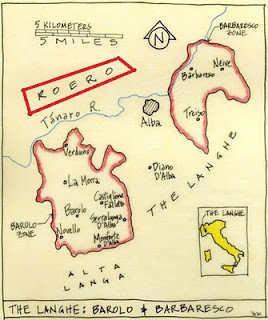
Map of the Langhe.

It's a source of some confusion at first that "Barolo" and "Barbaresco" each describe three different things: a village, a small-ish geographical zone surrounding the town, and a wine made from nebbiolo grapes grown in that region.

The village of Barolo lies some 8 miles southwest of the large town of Alba, which in turn is 30 miles southeast of Torino (Turin), the major city in the center of Piemonte. The village of Barolo is more-or-less centered on the winegrowing zone of the same name, which extends north to the village of Verduno, south to Monforte d'Alba, east to Serralunga d'Alba, and west to Novello. The other important villages are La Morra, just north of the village of Barolo, and Castiglione Falletto, just to the east.

The village of Barbaresco is about 5 miles northeast of Alba, perched above the Tánaro River. The village sits at the western edge of the Barbaresco wine zone, whose two other prominent villages are Neive to the east and Treiso to the south.

The Barolo and Barbaresco zones together compose the heart of the Langhe, an area that also includes the higher-altitude Alta Langa just to the south of Monforte. The three ubiquitous wine grapes of the Langhe are dolcetto, barbera, and nebbiolo. Dolcetto and barbera make Piemonte's wonderfully satisfying everyday wines, as we described in our March 2003 newsletter. Nebbiolo is the noble grape that makes Piemonte's - and Italy's - two greatest wines: Barolo and Barbaresco.

Nebbiolo also appears in more modest wines called either Nebbiolo d'Alba or Langhe Nebbiolo. These wines are made from nebbiolo grown outside the boundaries of the Barolo and Barbaresco zones or from vines that are inside the zones but that the producer chooses to "declassify" because the fruit doesn't meet his standards for Barolo or Barbaresco. Some of these wines are qualitatively different from Barolo and Barbaresco - lighter, fruitier, and meant to be drunk young. Others are in effect baby Barolo or Barbaresco, and can age for several years. In addition, other zones in Piemonte make excellent nebbiolo-based wines, including Roero, just north of Alba, and Ghemme and Gattinara, both well north of the Langhe, between Torino and Milano.

How great wines get that way

Our deeply bred sense of egalitarianism makes many Americans feel uneasy with hierarchy and the notion of greatness - at least when these notions are predicated of wine. A small amount of swirling, sniffing, and swallowing, however, suffices to convince most sentient beings that all wines are not created equal. Some wines are objectively better than others, and a few wines really do deserve to be called great. A bit more research reveals that great wines aren't randomly distributed - they tend to come from a few specific places. Two of those places are Barolo and Barbaresco.

Great wine requires these components:

Photo of autumn Barbaresco vineyard.
Barbaresco vineyard.

Piemonte is one of the blessed places on earth that has all of these components. It also has a superlative cuisine, harmoniously handsome landscape, and uncommonly generous and interesting people. I'm convinced that this combination is no coincidence.

Winemaking recipes

Barbaresco winemaking mural.
Traditional winemaking in Barbaresco, circa 1894.

Nebbiolo is a thin-skinned but tannic grape variety that tends to make well-structured, highly-perfumed, lighter-colored wines. Traditional winemaking practice in Piemonte emphasized these characteristics: Long maceration (i.e., leaving the juice in contact with the grape skins and seeds) extracted lots of tannins as well as fruit flavors. Aging in large, old, Slovenian oak barrels called botti did little to soften the tannins or deepen the color. Some of the resulting wines, when young, were almost undrinkably tannic, but those tannins provided the structure for long bottle aging. After a decade - or sometimes several decades - these traditional Baroli and Barbareschi became some of the finest wines on the planet.

(I've recently been able to drink some Baroli from the 1960s, and they are indeed remarkable. The wines had faded to a light shade of orange and exuded the most ethereal aromas. A 1961 Giacomo Conterno Barolo smelled like very old, exquisite Oloroso Sherry, although the palate was gone. A 1964 Barolo from the same producer remained vibrant and beguiling from start to finish.)

Photo of Luca Currado (Vietti) in front of a botte.
Luca Currado (Vietti) with a botte.

Beginning in the 1980s, Barolo and Barbaresco producers such as Elio Altare, Aldo Conterno, and Angelo Gaja began experimenting with more modern winemaking techniques: shorter macerations to reduce the amount of tannin in the wine, special fermentation vessels called rotofermenters to provide a gentler fermentation and maceration, and aging in smaller, newer French oak barrels called barriques. Barrique aging tends to soften a wine's tannins, deepen its color, and, if the barrels are new, impart oaky aromas and flavors. The resulting wines are much more approachable young. They also exhibit a softer, more luscious, more polished character that leans in the direction of other modern red wines.

These changes haven't come without controversy, however. Some producers and wine lovers decried the rush to a more generic, "international" style of wine - one that blurs the distinctive character of nebbiolo and the Langhe. The traditional advocates argue:

Unapologetic modernists dispute these points, especially #3 and #4, and the debate rages on. Someone of diplomatic temperament or catholic tastes might say: The more modern wines are supple and full, while still offering structure and age-ability. The more traditional wines exhibit a remarkable purity, with more delicacy and no lack of flavor intensity.

Photo of Luca Currado (Vietti) with barriques.
Luca in a cellar full of barriques.

Thus, you will hear about "traditionalist" producers (e.g., Giacomo Conterno, Giuseppe Rinaldi, Marcarini) and "modernist" producers (Elio Altare, Luciano Sandrone, and Marco Parusso, for example). Although these camps certainly exist, the majority of producers now use a blend of practices. Most producers have ratcheted back from 100 percent new oak barriques - they now use a mix of new and older barriques, and sometimes botti. Their goal is a wine that's reasonably supple upon release, but one in which the oak doesn't overwhelm the nebbiolo fruit.

Barolo and Barbaresco, whether traditional, modern, or somewhere in between, must comply with aging requirements that are established by Italian wine law - a minimum of three years for Barolo and two years for Barbaresco before they're released for sale. For example, the 2000 Baroli began arriving in our store just a few months ago. Wines labeled Riserva must be aged two years longer (five years total for Barolo Riserva and fours years total for Barbaresco Riserva). These aging requirements ensure that the wines aren't impossibly young when you buy them, although any decent Barolo or Barbaresco will benefit from additional bottle aging.

The Piemontese table

Piemontese cuisine is stupendously delicious - think Italian respect for the purity of great ingredients with a dash of French artfulness in preparation. It's no accident that the Slow Food movement started in Piemonte and still maintains its headquarters there.

Photo of cardoons.
Piemontese cardi (cardoons).

In Piemonte, Barolo and Barbaresco traditionally are special occasion wines - for a holiday feast at home, a special restaurant meal, or other celebratory occasion. That's partly because, until recently, most Piemontese were poor farmers. Those who made Barolo or Barbaresco sold most of it to survive and drank their everyday wines - Dolcetto and Barbera - instead. Fortunately economic conditions are considerably better now, and winegrowers can afford to drink their great wines more frequently. Nevertheless, they continue to treat these wines with great respect - serving them in suitable stemware and with appropriate food.

The intensity of Barolo and Barbaresco makes the wines best suited to heavier foods - especially game. One of the most memorable meals of my life happened on a fall afternoon in the village of Cissone in the Alta Langa. My secondo piatto was local wild boar and chestnuts braised in red wine, accompanied by a Barolo made by our host. If you haven't yet bagged a wild boar this season, don't despair. Less imposing forms of game, including game birds, make a great match with these wines, too: quail, game hens, goose, and venison, to name a few. (One PMW customer even asked us to recommend a Barolo to go with moose!) Several months ago, I tried a Moorish recipe from the excellent Moro cookbook - grilled quail with rose petals - and the floral qualities of a Barbaresco complemented it beautifully.

You shouldn't hesitate to serve Barolo or Barbaresco with more prosaic meats, either. Nebbiolo has a particular affinity for lamb, and osso buco is a natural partner. In fact, almost any kind of braised meat seems to bring out the best in these wines. When the urge to drink Barolo or Barbaresco takes me and I'm not in the mood for elaborate food preparation, I frequently make beef braised in red wine (its much more appetizing Italian name is brasato di manzo al vino rosso). The dish is ridiculously simple to make, as long as you have a few hours to let the meat bubble merrily away in its wine bath. I use Matt Kramer's recipe in his superb book, A Passion for Piedmont: Italy's Most Glorious Regional Table. (If you're interested in any of these recipes, just stop in the store and ask me for them.)

Photo of nebbiolo in decanter and stemware.
Enjoying Piemontese nebbiolo slowly.

Another option, and one that we exercise frequently at Paul Marcus Wines staff dinners, is to drink Barolo or Barbaresco after the meal, with parmegiano reggiano as its foil. This strategy turns the cheese course into a magnificent occasion. Italians speak of vini da meditazione, and it's hard to imagine a more rewarding way to meditate over a great wine than enjoying it slowly with friends after a good meal.

Speaking of enjoying the wine slowly, this would be a good time to reiterate the advantages of giving wine - especially great wine - the opportunity to develop its aromas and flavors through contact with air. Barolo and Barbaresco in particular benefit from aeration. Open the bottle well ahead of time - several hours isn't too much - and pour it into a decanter if you have one. (If you're taking the wine to a restaurant, uncork it at home, decant if it's convenient, and pour the wine back into the bottle and push the cork about half way in before you leave for the restaurant.) As you drink the wine, swirling it in the glass will release additional aromatic and flavor compounds. If you take the time to drink these wines slowly, you'll not only lengthen your enjoyment; you'll also derive the added enjoyment of participating in the wine's evolution in your glass.

For stemware, I like to use big Burgundy globes, because they accentuate nebbiolo's wonderful aromas. But any reasonably large wineglass that narrows at the top to allow safe, spill-free swirling will do just fine.

Vintages

Wine lovers love to discuss the merits of different vintages - sometimes to the point of neglecting more significant differences among producers, vineyards, and styles of wine in the same vintage! While vintage undoubtedly plays a part in the character of any wine, it is only one part. And some of the widely read wine publications are famously unreliable in their vintage assessments - they tend to over-generalize, to over-value intensity, and to under-value elegance.

Photo of Marina (Marchesi di Gresy).
Marina rinses glasses with wine at
Marchesi di Gresy in Barbaresco.

Everyone would agree, however that Piemonte was blessed with a six-year string of excellent vintages from 1996 through 2001. Here's my assessment of these vintages, based on visiting and talking with producers in the Langhe four times in the past two years and drinking the wines frequently, both here in the States and in Barolo and Barbaresco.

The 1996 and '99 vintages, in general, produced the most classically structured and beautifully balanced wines - so far. It's too early to tell for sure about 2001, because the wines aren't out yet. But my conversations and barrel sampling with producers last spring suggest that the '01 vintage will be at least the equal of '96 and '99. These three are the vintages that most producers speak most highly of (although no one is complaining about the other three in the six-year string!). Most '99s taste pretty young right now - they're impressive, but fairly tannic and tight. Some '96s are starting to drink well, and most have a long, delicious life ahead of them.

The 1997 and 2000 vintages are riper vintages, with wines of more fruit intensity and softer structure. Both are excellent, younger-drinking vintages, which is an advantage for those who don't have the cellar or the patience to age wines. At PMW, we've been tasting and drinking a lot of '97s from our warehouse lately, and most of them are absolutely delicious right now. They're old enough to exhibit some secondary aromas and flavors (that "slightly old wine" complexity), but young enough to retain good intensity and fruit. Wines from the 2000 vintage seem to have the highest "lusciousness factor" of any recent wines from Barolo and Barbaresco. Even young, these wines taste scrumptious and completely satisfying.

The 1998 vintage tends to get lost in the shuffle, as the wines are lighter in body than in '97 and '00 and not as impressively structured as in '96 and '99. But many '98s display a special balance of suppleness and structure, and many are drinking well now.

Incidentally, you may have read or heard that 2002 was a disastrous vintage in Piemonte. This claim is an uninformed overgeneralization. While '02 did break the string of six excellent-to-great vintages, it was not the widespread disaster that some people reported. The summer was cool, which caused problems for early-ripening dolcetto, and a localized hailstorm near La Morra wiped out the nebbiolo in a few vineyards. But fall brought more sun and normal temperatures, which allowed the rest of the nebbiolo to ripen normally. 2002 won't be a great Barolo and Barbaresco vintage, but there will be some good wines - and probably some good values (see below for one of them).

We currently have Barolo and Barbaresco from over two dozen producers, going back to 1995, in stock. I count close to 100 distinct bottlings, including a good selection from 1996 and '97! Although we display as many as we can on the shelves of the store, quite a few wines remain safely ensconced in our underground warehouse, so ask us if you're looking for something in particular.

Barolo and Barbaresco suggestions

Barolo and Barbaresco start around $40 per bottle - not cheap, but not expensive for world-class wine, either. (Just compare the prices of great Burgundy, Bordeaux, or California cabernet sauvignon.) That Renato Ratti Barolo 'Marcenasco' that initiated my love affair with the wines of Piemonte costs $40 for the 1998 vintage, and it's a bargain at that price. For about the same price, you can have the Cantina del Pino 2000 Barbaresco 'Ovello' ($41). It's from a single vineyard just north of the town of Barbaresco.

Photo of Mark reading the wine list at Marsupino.
So many great vintages, so little time.

Those whose budget or tastes run well below $40 need not be left out of the nebbiolo fun. As I mention earlier in the article, many Piemontese producers make a Nebbiolo d'Alba or Langhe Nebbiolo - in effect a "second wine" from younger vines, less favored vineyards, or vineyards outside the official Barolo and Barbaresco zones. Two current favorites are Produttori del Barbaresco 2002 Langhe Nebbiolo ($18) and Icardi 1999 Langhe Nebbiolo 'Surisjvàn' ($27). The Icardi nebbiolo is more full-bodied and rich, while the Produttori del Barbaresco wine displays more of the classic spicy, floral, and licorice notes that Barbaresco is known for. We carry other under-$20 bottles of nebbiolo as well as other wines from Produttori del Barbaresco, a producer of traditional, excellent value wines from this region.

From the much-talked-about 2000 vintage, we especially like Paolo Scavino Barolo ($45) and Elio Altare Barolo ($80). These wines display the supple lusciousness of the vintage and the elegant winemaking of two of the greatest modern-style Barolo producers.

Ettore Germano's Barolo 'Ceretta' is an excellent example of the firmer wines that come out of the sandier soils of Serralunga d'Alba. We're fortunate to have both the 1999 ($60) and 1996 ($45) vintages - the two classic vintages of the late 1990s. The two vintages would make a rewarding tasting or a superb dinner.

If it's older vintages that you're after, we've got those, too. We recently had the opportunity to taste Giacomo Borgogno's 1982 Barolo Riserva ($142) and 1967 Barolo Riserva ($152). Both wines are testaments to Barolo's capacity to age, and either would make a great birthday or anniversary gift - or star of an extra-special dinner.

This is a small sampling of the Barolo and Barbaresco that we have in stock. As always, we invite you to come into the store and talk to us about your wine preferences, dinner plans, or tasting event so that we can help you select the most suitable wines.


Go to Piemonte

also by Mark Middlebrook

Photo of Aldo Vacca (I Produttori del Barbaresco).
Aldo Vacca (I Produttori del Barbaresco)
explains Barbaresco and demonstrates
his conducting skills at the same time.

I made my first trip to Piemonte almost two years ago, in the late fall of 2002. I landed in Milano with a rental car reservation, a list of wine producers and their phone numbers, a copy of Italian With Ease (a pocket language book), and no particular plans. What followed was one of the most rewarding weeks of my life - not just for the wine and the food, which were indeed splendid - but above all for the deep beauty of the place and its people.

Piemonte lacks the artistic and architectural treasures of Italy's more famous regions. Yes, there are several handsome medieval and Baroque churches, some old frescoes therein, and an imposing castle in the town of Barolo, but no one goes to Piemonte for the art. Most of us go to eat and drink, not quite realizing the spell that this place will cast over us.

From the airport in Milano or Torino, the autostrada slices across a broad plain and past pleasant but nondescript towns until just north of Alba. Here the hills of the region known as the Langhe emerge from the plain, and things get interesting. These are foothills (Pie-monte means "foot of the mountain"), separated from the Alps by those broad flatlands. But they're rugged, intricately interwoven foothills whose complex topography rewards looking, walking, or driving...not to mention winegrape growing and other forms of agriculture. The Tánaro River meanders through these hills, creating a valley through which the road to Alba passes. From this valley, the Barbaresco zone rises to the east and Barolo to the south, while Roero, another hilly winegrowing region, lies to the north.

Alba is the geographical and cultural hub of the Langhe, and it's worth spending at least a few hours walking around this small, stately city. The centro is a web of cobblestone streets, lined by elegant cafés and wine bars, sophisticated Italian fashion on display, and useful shops such as bookstores, small groceries, and pharmacies. There's a big food market on Saturdays and a smaller one on Thursdays. In the fall, white truffles are the focus of attention, and you could do worse than strolling around and inhaling their earthy, beguiling aromas. Not surprisingly, Alba also boasts a concentration of excellent Piemontese restaurants.

Photo of the Langhe hills and Alps.
The Langhe hills and the Alps beyond.

But it's out in the small towns and countryside that the Langhe reveals its true character. I stayed in the village of Barbaresco during my first visit. It's a tiny place anchored at the end of a hilltop ridge by a squat, unfinished tower that's visible for miles around. The tower's bell clangs every quarter hour, so woe to you if you're a light sleeper! There's almost nothing going on, and yet it's become one of my favorite places to spend time.

From Barbaresco, one can see vineyards in all directions, the lazy Tánaro below, Alba, and the Roero hills and Barolo beyond. In autumn, the vineyards present a patchwork of yellow, red, and fading green. (I later learned that the different colors correspond to different grapevine varieties and soils - the patches form a living botanical and geological map.) Fog lingers over the vineyards in the morning, and the air can be hazy during the day. But once a week or so, the air clears and you awaken to the fact of how close you are to the Alps. Snow-capped mountains snap into view, and you walk around with your eyes wide open to everything far and near.

Just down the street from the Barbaresco tower is La Gibigianna, a splendid little bar run by Francesco Gigliotti - universally known as "Franky". He serves excellent wines by the glass (duh - this is Piemonte!), a great salad, and the best plate of artisanal cheeses I've eaten. Jazz music plays on the stereo - rumor has it that Franky blows a mean saxophone - and a group of old men sits at a corner table, playing cards, drinking wine, and telling jokes in Piemontese.

Piemonte has its own language, which lies linguistically somewhere between Italian and French. For example, the Piemontese phrase for "good wine" is bon vin, pronounced in a nasalized fashion - approximately "bohng ving". Almost everyone speaks Italian, but it's not uncommon to hear Piemontese in homes, vineyards, and wine cellars, especially when the conversation is among older people. On a subsequent trip, I visited dolcetto producer Anna Maria Abbona in the Alta Langa, south of the Barolo zone. (Anna Maria's Dolcetto di Dogliani 'Sorí Dij But' is a favorite in our shop.) During the tasting, an old woman, Anna Maria's neighbor, came in to sell her some eggs. There was some confusion about the price, because, several years after the conversion to euros, the old woman still thought in terms of lire. Their friendly argument in Piemontese was like listening to a version of Abbot and Costello's "Who's on First?" in a vaguely familiar but mostly forgotten ancient language.

Piemonte boasts an astonishing density of exceptional, reasonably priced restaurants. You can hardly turn around without bumping into an excellent trattoria or osteria (small restaurant with a limited menu). There are fancy restaurants, too, of course, but the food isn't necessarily any better than in the more modest places. Barbaresco, a village of some 600 souls, boasts three excellent restaurants, in addition to Franky's wine bar.

Photo of chefs at Il Verso del Ghiottone.
Chefs at Il Verso del Ghiottone in Dogliani.

Everything about eating in Piemonte is civilized without being precious. As in most of Europe, dinner is a leisurely affair, lasting from when you show up until the restaurant closes. It begins with a slow parade of antipasti served in sequence, each on its own plate. These stunningly delicious antipasti are the glory of Piemontese cooking, so it's only right to savor each one separately. Then come the primo piatto (usually pasta or risotto) and secondo piatto (usually meat or fish). Of course, few of us can consume this much food night after night, so seasoned Piemontephiles know to skip either the primo or secondo. For those with superhuman appetites, there's cheese and then dessert. For the rest of us, there's coffee (always straight espresso; Italians blanch at the idea of consuming milk after a large meal) and then a digestivo (usually grappa).

Thus far, I've made it sound like Piemonte is just another place with great food and wine and a handsome landscape. It is all that, but my experiences with the people there are what keep luring me back - four times so far.

My first Barolo visit was to the cantina of Mauro and Daniela Veglio, just south of the village of La Morra. As we were sitting and tasting wine, their friend Emilio appeared. He looks like Bacchus and, I soon learned, plays the part - as co-owner of an osteria called La Salita in Monforte d'Alba, a few miles south of the villages of La Morra and Barolo. Although Emilio doesn't speak English and I spoke little Italian on that first trip, we managed to communicate through my Spanish, his German, and much hand signaling and laughter.

Photo of Mark, Nico, and Pete in La Salita.
Drinking Franciacorta at the bar
in La Salita.

The next night, I drove down to La Salita for dinner. Emilio's partner, Mariangela, prepares excellent, traditional Piemontese food with a light touch. I especially love her agnolotti - tiny ravioli that serve as one of Piemonte's signature dishes. Emilio puts together the phenomenal wine list and plays host - offering complimentary Champagne or Franciacorta (Lombardese sparkling wine) to patrons who cluster around the bar before being shown to their table. Emilio is a great lover of sparkling wines himself, and the bubbles only enlivened our fractured and often hilarious attempts at communication.

Because I had come alone, Emilio introduced me to local winemaker Giorgio Conterno and his two guests at the bar, who quickly insisted that I dine with them. We ate well, conversed well (one other person spoke English; I got bolder in my limited Italian), and took turns ordering bottles of Barolo. Several nights later, I brought two new expatriate friends to La Salita and introduced them to Emilio and my growing circle of acquaintances there. It's the same each time I visit - as I walk through the doors, Emilio flashes his Dionysian grin, greets me as "Marco dalla California!", and fills a flute with Franciacorta. Mauro and Daniela Veglio, Franky from La Gibigianna, or someone else I've met elsewhere in the Langhe shows up. We reconfigure tables to sit together or send bottles of wine back and forth between our tables. After the meal, we often regroup at the bar for grappa or a few rounds of "guess the mystery bottle". (The stumpers have included Piemontese merlot, New Zealand shiraz, and Sean Thackrey Pleiades from Bolinas, California - the latter brought by an Englishman!)

Photo of Mark with Carlo Riccati (Il Colombo).
Tasting dolcetto with Carlo Riccati.

Emilio and the growing group of friends that he's introduced me to form one strand of my Piemonte connection, but there are plenty of others.

Janene Silverman and Beppe Canavero are an American-Piemontese couple whom I got to know thanks to one of our Paul Marcus Wines customers. Janene's cooking skills - she started Zza's Trattoria in Oakland before moving to Piemonte - and Beppe's deep knowledge of Piemontese culture have inspired many wonderful meals and conversations. Janene also introduced my wife, Cheryl, and me to the proprietor of Mulino Sobrino, who spent hours explaining ancient Piemontese grains and traditional milling practices to us. (Janene organizes and leads trips in Piemonte: http://www.foodwineitaly.com/.)

Carlo Riccati and Adriana Giusta became wine producers by accident when they discovered that the house in the Alta Langa they bought to retire to included the best dolcetto vineyard in the region. Cheryl and I spent a frigid November morning warming ourselves next to their beautiful, German-made ceramic stove. As we tasted dolcetto and nibbled crackers in their kitchen, Adriana called around to find us a suitable agriturismo (rural B&B) in the local area.

I could go on, but you get the idea. At every turn, I've met interesting, passionate, and generous people in Piemonte. Wine and food are great, but the way in which they bring people together is the best of all. And for me, the Langhe has the best of this best.


I'm going back to Piemonte for the Vita Vera Italia / PMW wine and culinary tour November 1-7. Consider joining the tour, details of which are at http://paulmarcuswines.com/piemonte_tour.html.


More on the Way

We publish newsletters every few months and send them out via e-mail. In addition, we post all issues of the newsletter, plus maps and photographs, on paulmarcuswines.com. If you like what you've read so far, then sign up for e-mail delivery of future newsletters by sending an e-mail message to info@paulmarcuswines.com. And don't worry - we will never, ever sell, rent, or give away your e-mail address.


Return to the Paul Marcus Wines newsletter page.
Go to the Paul Marcus Wines home page.
Copyright © 2004 by Paul Marcus Wines.
First posted on 23-Sep-2004. Last updated 10-Oct-2004.